Nevada-Utah-Arizona
June 23-July 1st 2017
1765 mi
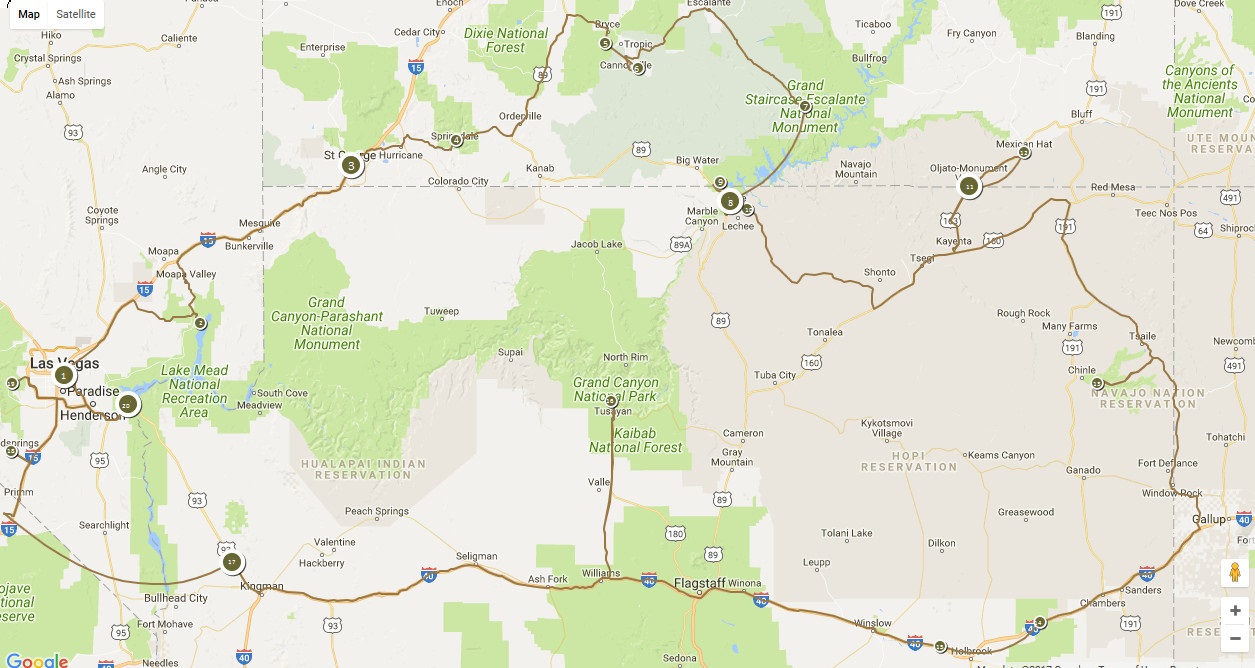
Jun 23th — Las Vegas, NV * Valley of Fire, NV * St. George, UT
Jun 24th — Zion, mt Carmel Highway, UT * Bryce Canyon, UT * Escalante, UT * Page, UT
Jun 25th — Glen Canyon Dam, AZ * Lone Rock Beach,UT * Horseshoe Bend, AZ * Monument Valley, UT * Mexican Hat, UT
Jun 26th — Monument Valley, AZ * Canyon de Chelly, Chinle, AZ
Jun 27th — Petrified Forest National Park, AZ * Joseph City, AZ * Grand Canyon Village, AZ
Jun 28th — Grand Canyon Village, AZ * Spirit Mountain, NV * Ivanpah Solar Electric Generating Systemno, CA * Goodsprings, NV
Jun 29th — Red Rock Canyon, NV * Boulder Beach, NV * Hoover Dam, NV * Las Vegas, NV
The journey began on a glorious Friday morning, when we landed in Las Vegas airport welcomed by the summer heat of F 105 degrees and casino posters all around. That day we were bound almost straight into the wilderness, but of course on our way we drove along the famous strip, to get a quick taste of the notorious Vegas buzz. We comfortably settled in our rental Santa Fe, with the “Fear and Loathing in Las Vegas” audio book accompanying us, we set off to our first Natural landmark – the Valley of Fire State Park. We drove for at least two hours and found ourselves surrounded by miles of desert and red rock formations of evocative shapes.
Only vastness’s around us and a road that can take through the magical atmosphere of the park. Indeed, the scenery reminded of a fire frozen in time, or ossified sand dunes, or some unnamed creatures living their own quiet and thoughtful life…We got out of the car at the Atlatl Rock to see Native American thousands-years-old petroglyphs on a flat surface of a giant boulder. It was mesmerizing to be that close to pre-history, face to face to the messages of an era and culture of which there is so little left, but so much yet to be understood about. We kept driving forward past the ridges and by the dusk left the park. It was close to midnight when we reached the City of St. George in Utah, we were to rest overnight after having had a fulfilling first day and a filling meal in one of the diners that was fortunately open that late.
On our second day, we intentionally woke up and set off early to beat the arrival of the heat and get to our next destination while full of energy. The air was filled with carbon smell from wilderness fires miles away to the south of us and smoke created a faint haze all around. Nonetheless, we reached the gorgeous and whimsical Zion Park. We took the Caramel Way through it and captured the memory of the beautiful flora nestled within the canyon. Next, we reached Bryce National Park situated within Dixie Forest. Dramatic and vast, the canyon’s scenery and scales strike anyone infallibly, but…it doesn’t hold one’s attention for too long. There is something unnerving in such vastness. Or maybe lack of greenery and carbon dioxide excess in the air made me less perceptive to the majesty of Bryce Canyon. Off we were to the next destination!
Long ride through the rocky valley took us towards the Escalante Monument. In complete darkness, everything looked otherworldly and beautiful. Just before the dusk, we stopped and for two minutes listened to the grasshopper’s chantey in the stony desert, outside the car. We made it to the city of Page, finally. Around midnight, we found a place to rest near Glenn Canyon Dam. The stars were shining brightly.


As we woke up in Arizona, the Sun welcomed us with its heat and didn’t release hold of us even in the shade. We started by investigating a concrete arch-gravity dam on the Colorado River. Glen Canyon Dam helps ensure distribution of water between the states of the Upper Colorado River Basin (Colorado, Wyoming, New Mexico, Utah) and the Lower Basin (California, Nevada, Arizona). During years of drought, Glen Canyon guarantees a water delivery to the Lower Basin states, without the need for rationing in the Upper Basin. The dam is also a major source of hydroelectricity. Water managers and utilities state that the dam is a major source of renewable energy and provides a vital defense against severe droughts.
At the dam, we explored the local maps closely and determined our itinerary for the next two days. To treat ourselves for long drive and get more energy for the day, we went to the Lone Rock Beach for a swim in Lake Powell. In a proximity to us the new destination was awaiting. Regardless of the midday heat, walked a mile or so towards the Horse Shoe Bend Canyon. Looking down from the edge of the cliff at the emerald-colored meander of the Colorado River was akin to the experience of discovering an oasis in a desert. Unique and eloquent were the patterns and the nature’s design.
For the next three hours we kept driving west, to reach the magical Monument Valley on the Arizona–Utah border, within the range of the Navajo Nation Reservation. The nature’s architecture and, more importantly, the aura of the place were breathtaking. The valley’s prominent feature was clusters of vast sandstone buttes — stratified tall formations of stone. We felt a little befuddled, slowly driving along the empty highway while the scenery was unveiling itself to us. We drove further in search of a nearest settlement, and luckily found Mexican Hat town, where we had the best milkshake we ever tried. The decision was made to come back to the Monument Valley and rest overnight at the nearest camp ground. The awakening at the sunrise was just as phenomenal as the valley itself and we felt grateful.
Our next goal today was to explore the Navajo National Monument and its well-preserved cliff dwellings of the Ancestral Puebloan People. We hiked down the designated trail to see the Kiet Siel dwelling in the cliff alcove, which was first occupied at around 1250. Due to the extremely dry climate and natural overhanging cliff the site and artifacts are well preserved; the structures were mainly built of sandstone blocks and plastered together with mud and mortar. Such was the example of a preserved tribal residential architecture, the first one I have seen of such kind. It was not easy hiking back up the hill to the trail head, but with a steady pace we reached it, short of breath, yet feeling accomplished. We took an hour to rest and enjoyed picnic in the shade of trees. After that we drove to our next destination within the boundaries of the Navajo Nation – Canyon de Chelly National Park, which preserves the ruins of the early indigenous tribes (Pueblo Peoples) that lived in the area. Some Navajo families still live in this land. The site features the three major canyons which were cut by streams thousands years ago. The views were very distinctively peaceful and quiet. The distinctive feature was the Spider Rock — a tall sandstone spire that rises from the canyon. According to traditional Navajo beliefs the taller of the two spires is the home of Spider Grandmother, who is creator of the world and responsible for the stars in the sky. Every view imparted good energy and timelessness. However, every now and then we came across the Native youth selling hand-made art. I saw need in their faces.
We were leaving De Chelly during the sunset and took highway 191 to reach the Petrified Forest. That road was running amidst wast grasslands and all we saw in front for a while was mauve-colored sky and golden rays of the setting sun. The land seemed to live its own life here, untouched. It was beautiful to witness its quiet aliveness.
By midnight, we reached the Petrified Forest with a hope to settle at one of the campgrounds inside the park. The entrance gates were closed, however. Not having any energy to drive any further, we fell asleep in the parking lot right in front of the gate.


Petrified Forest National Park, where we spent that morning, is an area of eroded and colorful badlands, containing large deposits of petrified wood. Those pieces are fossils of fallen trees that lived in about 225 million years ago and became coated into sediments. The examples of extinct tree species are triassic ferns, cycads and ginkgoes. Human inhabitants presumably first arrived at least eight thousands years ago and fortunately many engraved petroglyphs still remain. Once again, we were face to face with prehistory, humbled by the power and beauty of evolving life.
On our way to the next destination we were lucky to drive along the U.S. Route 66 – one of the original highways in the country (built 1966). As we expected, on both sides of the route were few ghost towns abandoned gas stations intermixed with small road-side businesses still in operation. One of the tiny towns -Joseph City,was located in proximity to the coal power plant. We remembered two things: that “the beast thing about Jo City is its People” and that there are no milkshakes there. On and on our route was leading further with me just chilling on the back seat and Yury restlessly driving. We were reaching the Grand Canyon South Rim around sunset. Somehow we were just on time at the viewing point, watching the canyon lit up in golden. After everything we have seen prior, the scenery at that moment was almost too vast to be absorbed. Yet we stayed until it turned completely dark and stars became visible. We said very few or no words. Afterwards, we grabbed a late night dinner and were fast asleep at the hotel parking lot.


The morning next day was most memorable through the entire trip. Waking up and seeing vastness, depth, and unusual colors of Grand Canyon lit up by the morning sun, though the rock itself was breathing and renewing itself in front of our eyes. Another long ride was awaiting us, but that day we were well rested. Our goal was to reach Nevada by evening. On our way we stopped at Santa Claus – an abandoned little roadside place on the west shoulder of U.S. Route 93. The place was designed in 1937 by a real estate woman who planned to use the Santa theme in a desert location to attract buyers for the subdivided land. The project didn’t materialize, but a couple of vandalized buildings with the hand-painted renderings of Santa still remain.
As we continued on Route 93, we veered off to the Spirit Mountain Wilderness Area in Nevada, close to the Lake Mead National Recreation Area. The name was very proper, as we could feel the mystery within its surrounding’s. Some of the cliffs contained numerous petroglyphs of the native Indian Yuma people, who presumably believed that all life began on this mountain.
Once we made our way back out of the wilderness, we opened our beers. It was very timely, considering that we had to drive through the back country roads for another five hours – which we definitely didn’t expect. We drove past Ivanpah dry lake and observed the monumental Ivanpah Solar Electric Generating System from afar. Nothing but grassland stretched for miles around us. The road lead us towards a small town of Goodsprings, NV. The town was once the heart of the most productive mining districts in the county. We visited the old Pioneer Saloon, which is still perfectly functioning and is considered one of the oldest saloons in Nevada.
It seemed to us so logical that the rest area would turn up soon – so much we have driven and seen that day. However, the dusk was setting in, but the rough back country road from Goodsprings had no ending for another three or four hours. I only admired Yury’s ability to pass endless bumps and holes in the road and continue without pause until we reached the Red Rock area. That day we were beyond fulfilled and exhausted. The adventure was yet to be resumed at the dawn.
Sleep has a miraculous quality to reset us and every time it helped us to get up sane and start the day with joy. This morning we were to circle through the Red Rock Canyon Scenic Loop Drive, which was of course wonderful. But what we really needed is to be in the water, so we headed to the Boulder Beach nearby to swim in almost transparent Lake Mead. There we finally felt entirely restored, awakened, and grateful for the charms of nature we have been witnessing so far. The last destination on our official itinerary was Hoover Dam – the man-made marvel that can control floods, provide irrigation water and produce hydroelectric power to Nevada, Arizona, and California since 1931. The structure presents architectural details in elegant Art Deco style, while some interior features incorporate motifs of the Native tribes of the region.


Our adventure in the South-West was not to end until few days later due to strange, unplanned circumstances 😉 . Nonetheless, we were happy with the impromptu road-trip and its unpredictable swerves! Until next time, wild American South-west…
I

“No sympathy for the devil; keep that in mind. Buy the ticket, take the ride…and if it occasionally gets a little heavier than what you had in mind, well…maybe chalk it up to forced consciousness expansion: Tune in, freak out, get beaten.”
― Hunter S. Thompson, Fear and Loathing in Las Vegas

 Beloved Earth. Sketches from the Temple