A dialogue between the Ocean’s coasts: What the parallels between ancient indigenous arts of the Pacific North-West and the Chukotka Peninsula remind us of.
Ten years of life had passed in the Pacific North-West and gradually it became my second home. Even more so, it became a cradle for my spirit. The fierce waters of the Pacific Ocean, the powerful presence of the Cascade mountains, and the mysterious depth of the Olympic Peninsula's lush rain forests seemed to be imbued with far more knowledge than any book could ever tell me. For long, I kept listening and paying attention. I kept immersing myself in the wilderness and nourished reverence toward the treasure of wisdom firmly woven in the centuries-old indigenous culture, which is inseparable from the land which I grew to love and cherish so dearly. I left the Pacific North-west few years ago. While the currents of life have since taken me to diverse spots on our planet, I carry the gratitude to the land in my heart, thus remaining connected to it. The ongoing exploration of indigenous arts allows me to perceive the cultural heritage of the land deeper and, through profound appreciation, understanding, and discovery, share the immanent beauty of it with the world. It is by learning about each other's culture we learn about ourselves as a human family and come to realize how related we are at the root.
November 2024, New York, Metropolitan Museum of Art:
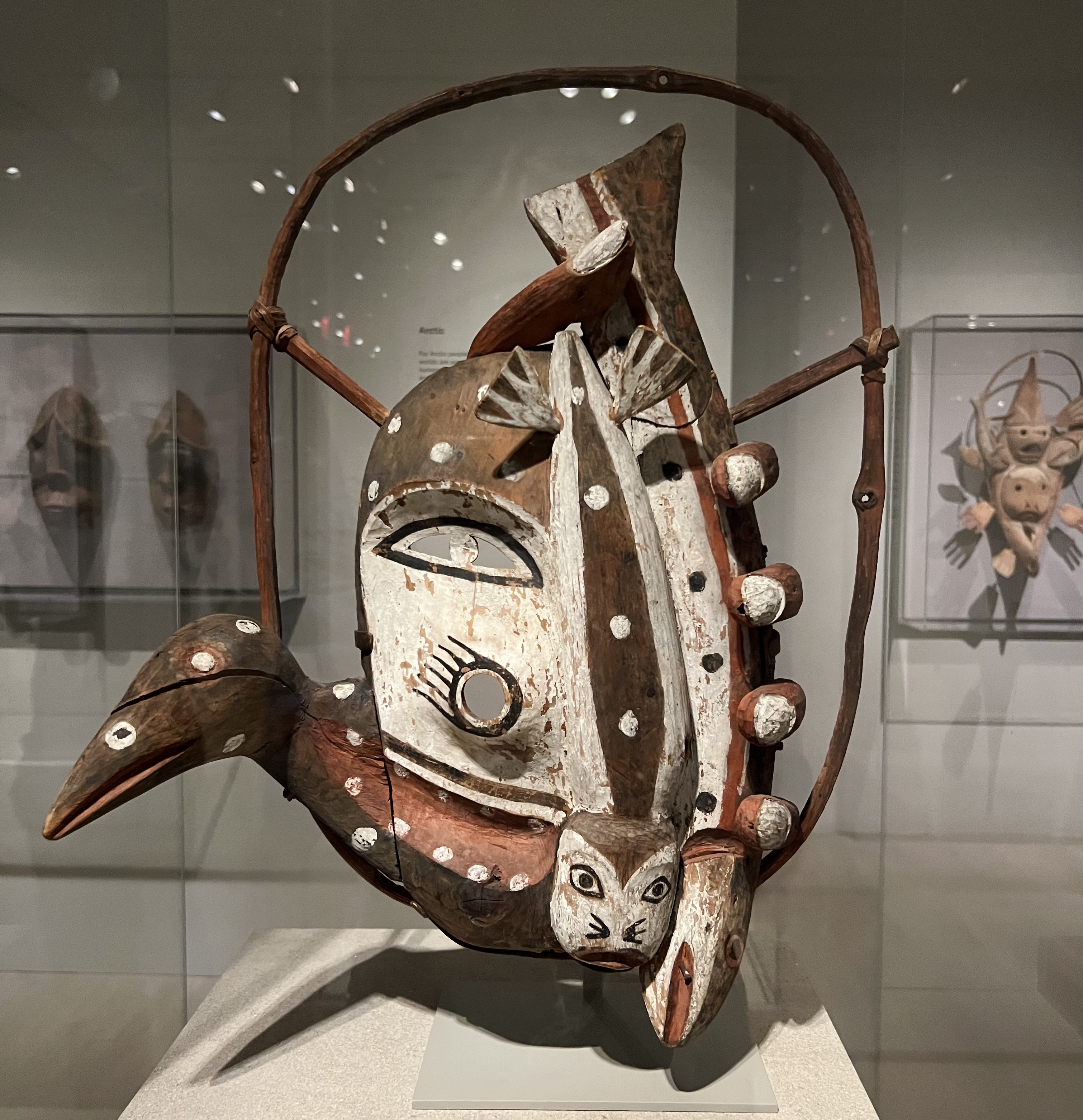
Alaska, ca. 1900
Wood, pigment
When I saw a ceremonial indigenous dance mask exhibited at the Met’s exhibit of the Pacific North-West Native American Art, I paused, mesmerized. The mask was probably perplexed by my reaction, too. It was an early XXth century artwork, size of a large human hand, by the Yup’ik tribal artist from Alaska. The mask is surrounded by the bentwood hoop, which symbolizes the border of the universe and encloses images of a humanoid spirit face, a seal, a fish, and a bird. According to the description label, a dancer would wear the mask in a winter ceremony honoring the animals who gave their lives during the year and ensuring their return in the coming season. The artwork represents nothing less but the collective life force of all creatures past, present, and future embodied in it. I was struck by the artistry and pondered the wealth of ancestral cultural knowledge that was embodied in the mask – the concise and eloquent symbology of the art piece expressed philosophical and spiritual worldview of the native people and reminded the contemporary onlookers of something we all seem to have forgotten in the rash of life – of interconnectedness of everything in the universe, of the union of earth and sky, of transience of everything perceivable and the reverence for the eternal and unchanging force governing the universe.
I moved on exploring the exhibition, where every piece was a jewel. Another artwork, created by the artist from the same region in Alaska grabbed my entire attention again: Within the bentwood border of this mask, a hunter’s kayak searches for a stone quarry. Near the center of the boat, the face of a humanoid seal spirit emerges, with another unidentified spirit above it. The tiny bird head at the bow may portray the hunter as seen through the eyes of his prey. Fish and flippers surround the vessel, representing the supernatural animals that slip through the thumbless spirit hands and into the physical world to be hunted.
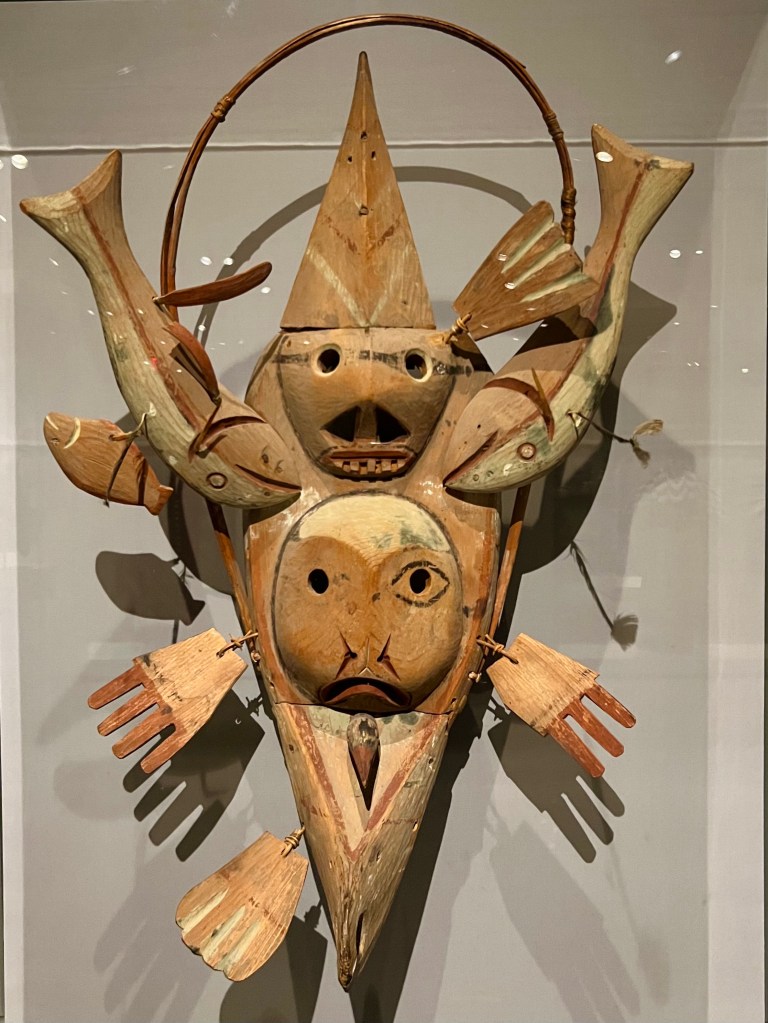
Alaska, ca. 1900
Wood
The beauty of both masks, the unique style of craftsmanship, and the cultural meaning they exhibited were louder than words. The artworks were not revealing anything drastically new to me, yet the ways they interacted with me and reminded me of the deeply embedded meaning that the native peoples culture has been preserving for millennia – that was fascinating. Despite this legacy of colonization process that began in the region in the 18th century, the ideas, symbolism, and materials of the past are alive in Alaska’s contemporary arts, reflecting deep connections with the land, sacred traditions, and cultural protocols that have evolved over thousands of years1. The next two pieces are fine examples of the native bone-carving technique:
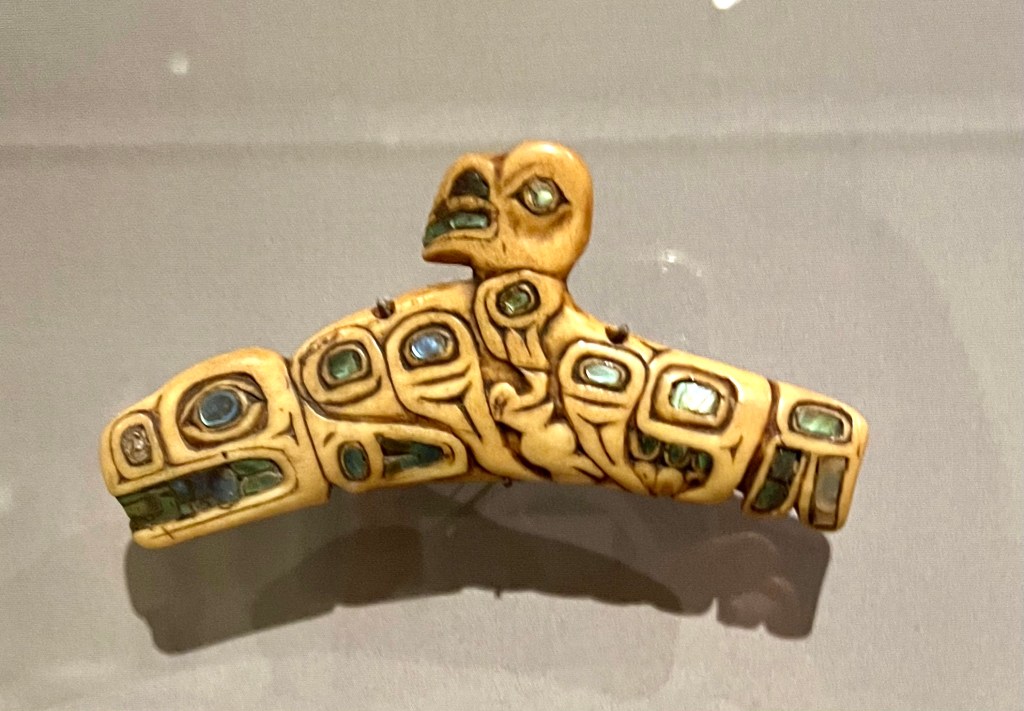
Alaska, ca. 1840
Antler and abalone shell
This amulet is carved in the shape of a whale: its head, pectoral fins, and tail are clearly outlined. However, in place of the dorsal fin, a figure that is likely a Thunderbird holds a juvenile whale in its talons. Made of antler, the object depicts powerful images that likely represent a person’s inner world. A row of ovoid shapes with shell inlay represents the whale’s vertebrae.
Pacific Northwest Coast cultures are known for their refined sculptural works and complex system of abstract pictorial imagery, termed formline by art historians. Consisting of ovoid forms and shapes within structures of continuous curvilinear lines, the distinct style is used to represent a variety of beings in ivory and wood carvings.The engravings ornamenting the figures with rhythmic succession of lines reveal peculiar plasticity of the sculptures and impart mystery and fantasy to them.
According to the indigenous totemic beliefs of this region, animals and people shared common ancestors and were bound by an inseparable kinship bond; killing an animal was tantamount to killing a human. However, hunting was not considered murder, as it was believed that the animal voluntarily provided its meat to humans. It dies, but after special rituals, it returns to life. Artists frequently make works displaying animal ancestors and clan lineage. Masks, rattles, and amulets employed by shamans in elaborate ritual performances affirm societal structures and cultural origin stories.
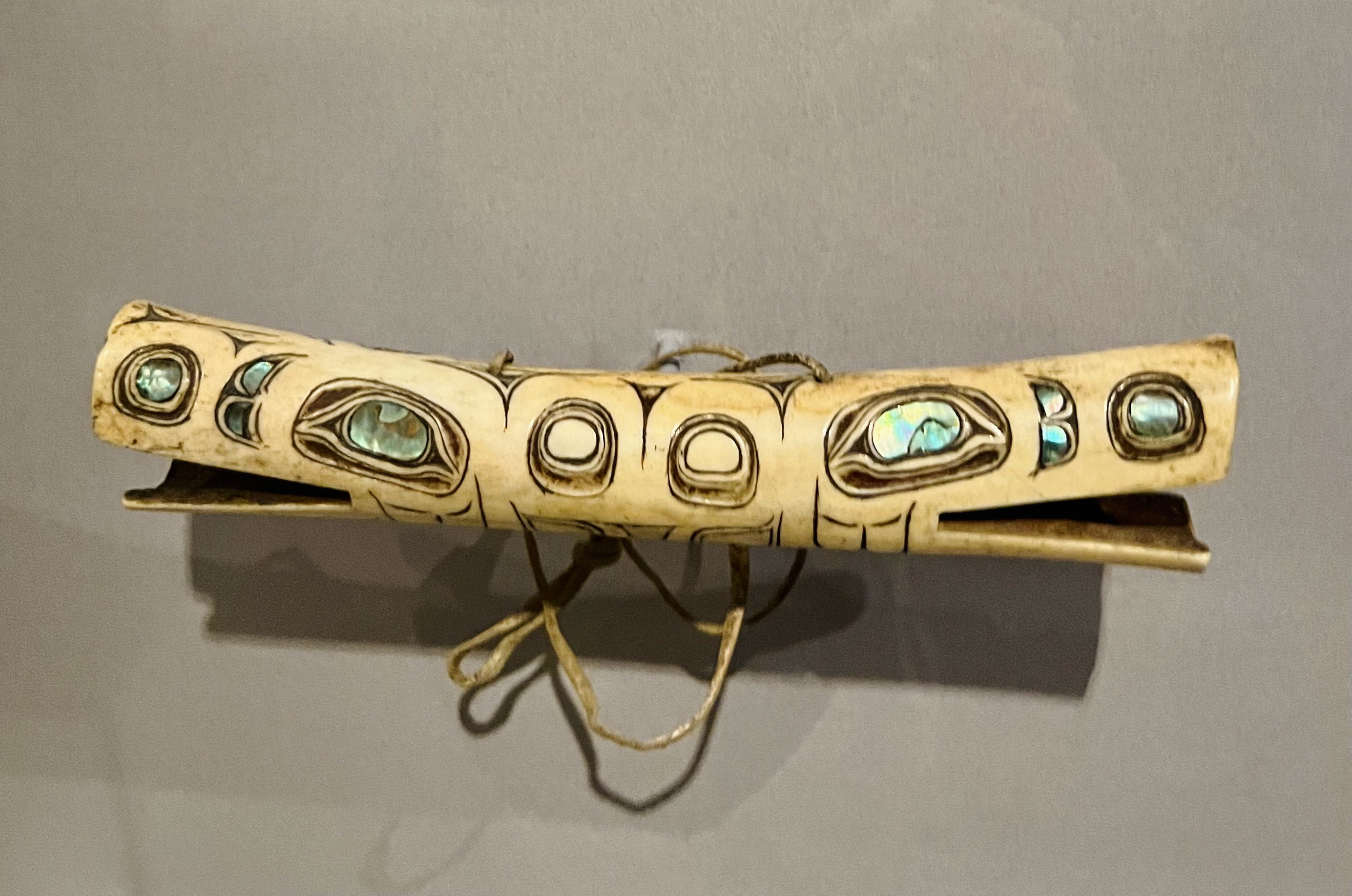
British Columbia, ca. 1840
Bone, abalone shell, and tanned leather
This double-headed carving was used to restore balance and good health. The two animal heads may represent wolves, or other animals, who help guide the process. Created by a Tsimshian artist using an animal femur, the abalone shells for the blue-green iridescent inlays give the eyes a lively presence.
The sheer aesthetics of the next piece pulled me as if it was a magnet. It was a Headdress Frontlet, created by a Tsimshian artist from British Columbia in the early XIX century. This exquisitely carved piece would be attached to a headdress and likely worn for communal or ceremonial dances. The materials and imagery reflect reciprocal connections between humans and their natural environment, specifically land, sea, and sky. A bird with human-like features, perhaps a hawk, appears in the center. Along the rim, panels of iridescent abalone shell alternate with small human faces, four of which are depicted with their eyes closed.
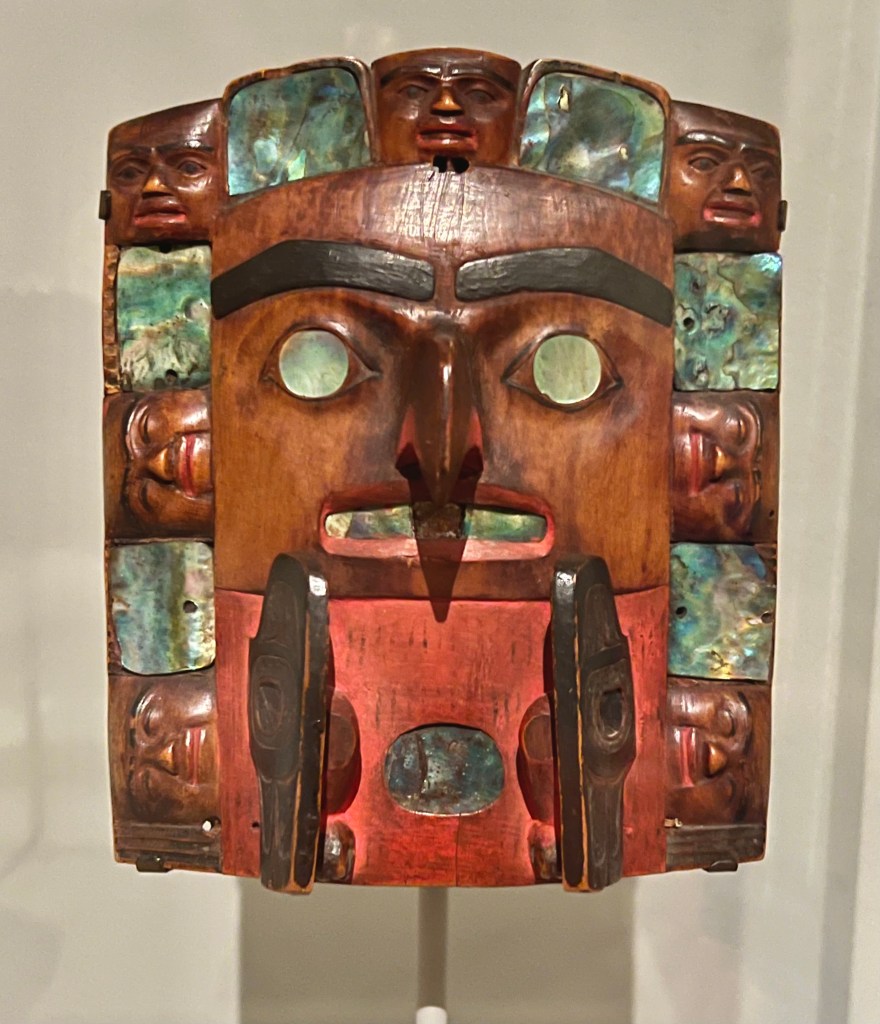
British Columbia, ca. 1820
Wood, abalone shell, pigment
What I saw exhibited on the next display was a treasure of indigenous coastal Arctic art: four ancient walrus ivories representing finest examples of cultural heritage from Old Bering Sea peoples who inhabited the coasts and islands of the Bering Strait between Alaska and Siberia more than 1,500 years ago. Arctic indigenous art… How little did I know of it!
For indigenous inhabitants of the Bering sea coast, the boundaries between the spiritual and human worlds are permeable, and artistic forms express the worldview that humans, animals, and spirits exist in a state of reciprocal exchange and potential transformation. A strong belief in animism and the need to placate the spirits was the basic to the ancient Escimo culture. The process of depicting polar animals, the most frequently portrayed subject matter of their art, was beneficial for the hunters’ deeper understanding of the northern nature and of human beings as an integral part of it.
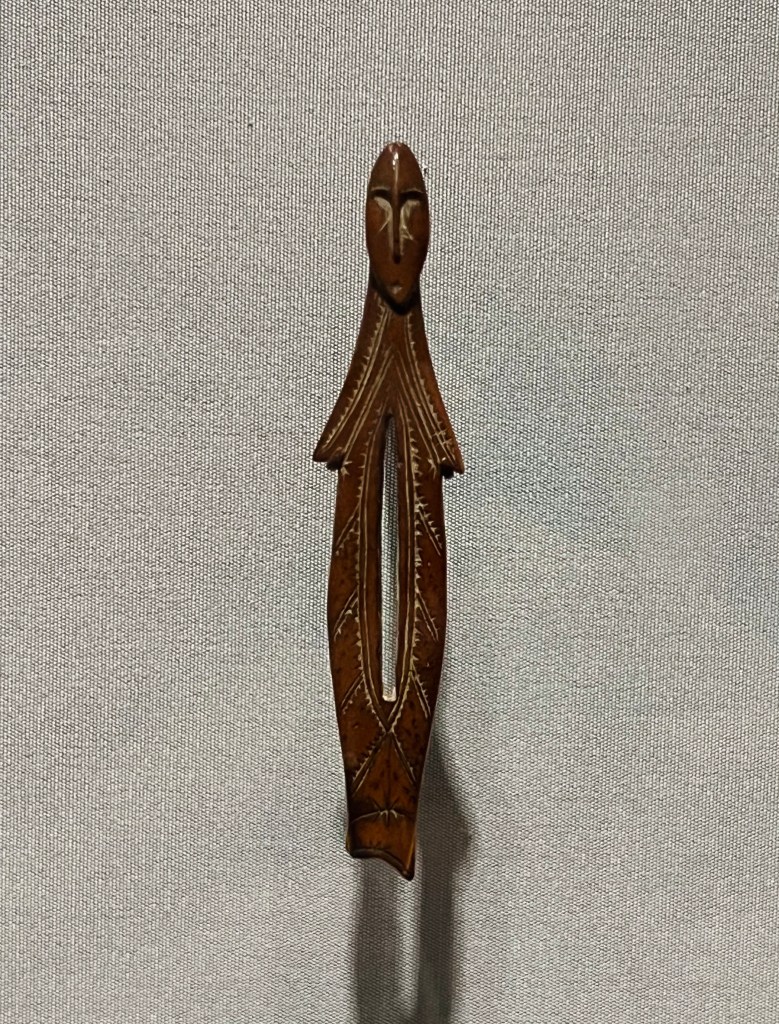
Bering Strait region, Alaska, 100 B.C.- A.D. 200
Walrus ivory
These four objects represent a centuries-old Arctic tradition of carving and incising walrus ivory to create human and animal figures and small utilitarian tools that are also sculptural artworks. The intricacy of the engraved designs on these ivories is remarkably revealed in the Transformational Figure, executed by Okvik artist from Bering Strait region around 100 B.C.- A.D. 200. This female figure with an elongated head and torso appears part-human and part-sea mammal or fish. Although its exact purpose is specific to the owner, the narrow opening at the center may signify the boundary between the physical and spirit worlds. Carvings such as this one are considered to be among the most aesthetically refined of the Old Bering Sea sculptural works.
The next art piece is identified as Handle Fragment and is done by an artist from North Alaska, which constitutes a portion of what is historically known as the Old Bering Straight region. The piece dates back to A.D. 100-300. Nearby the handle there is an elaborate Toggle which likely represents a polar bear or wolf – identified by the long muzzle, exposed teeth, and small swept-back ears. It is executed by an Alaskan Okvik artist from the same region around 100 B.C.-A.D. 200. The surfaces of these two objects – the Handle and the Toggle – are enlivened with finely engraved circles, ovoid shapes, and lines.
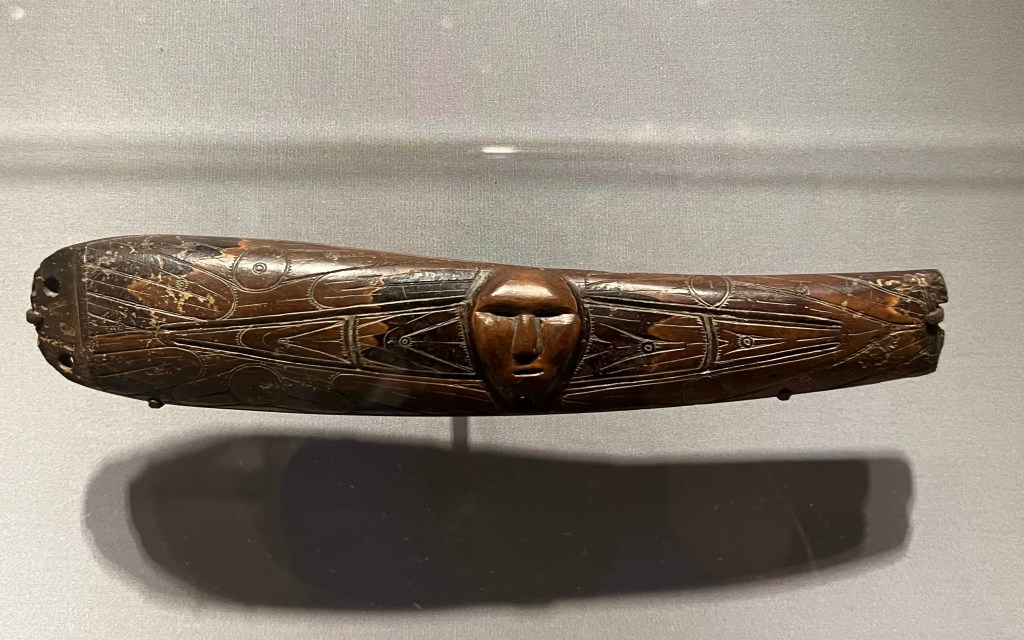
Bering Strait region, Alaska, A.D. 100-300
Walrus ivory
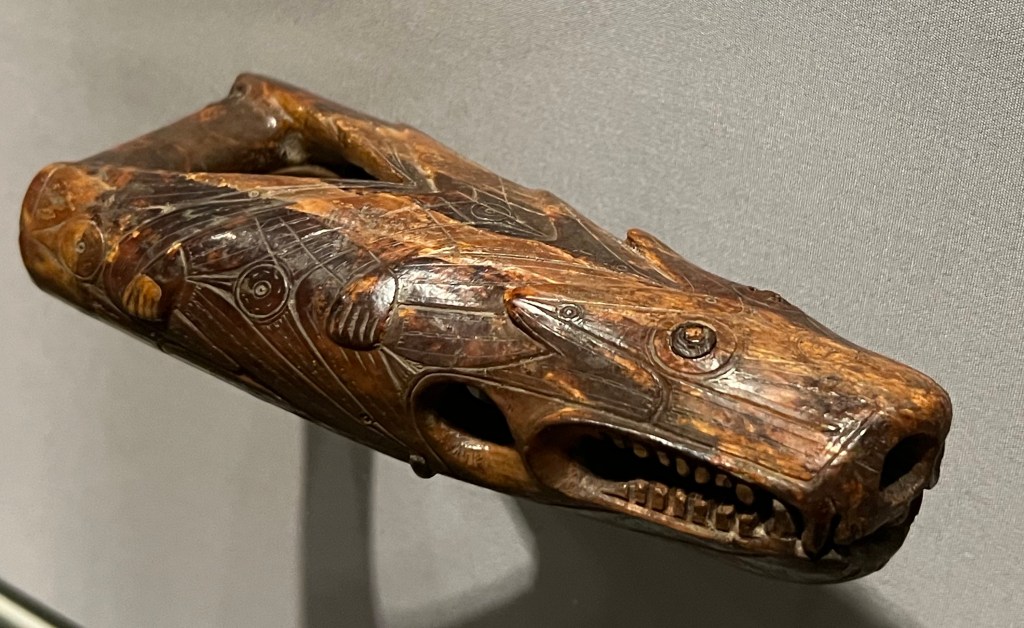
Bering Strait region, Alaska, 100 B.C.-A.D. 200
Walrus ivory
The artwork that I saw next became the reason for this essay. It was a Harpoon Counterweight from the Bering Strait region (North Alaska), dated A.D. 300-500. For hundreds of years, the harpoon was an essential tool for hunting big fish and sea mammals in the Bering Sea. Carvers used walrus ivory to make components of the long, spear-like instrument, including its counterweights or stabilizers, sometimes referred to as “winged objects” because of their shape. The purpose of these pieces had remained mysterious until recently, but as a result of archeological research, it was possible to determine that the function of «winged objects» was the same as the arrow’s feather. Nonetheless, it is likely that “wings” had both the functional and symbolic meaning. As such, the shape of counterweights may have another explanation, which stems from the ritualistic aspect: some of the most archaic samples of “winged objects” resemble the upper cervical vertebra of the spine named “Atlas”. Remarkably, according to the representations of the Eskimo, humans and animals had several souls, and the main soul lived in Atlas.
The four small carvings exhibited wealth of history, beauty, and functionality, which, however, only provides small pieces to the puzzle that constitutes our fragmentary present day understanding of Native North American and Arctic art.
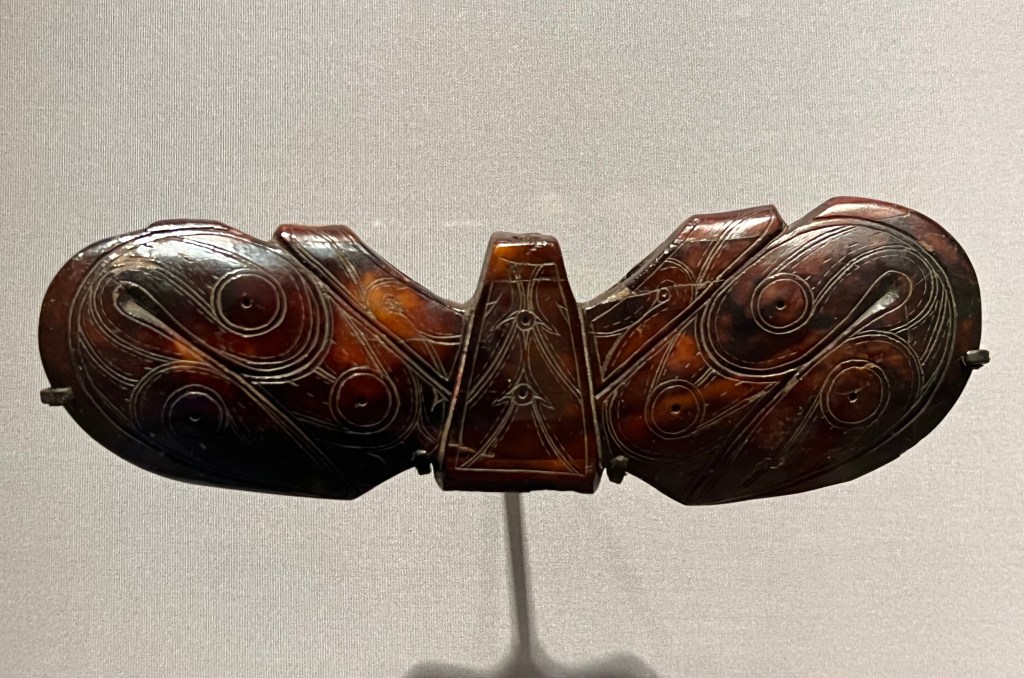
Bering Strait region, Alaska, A.D. 300-500
Walrus ivory
July 2025, Moscow, the State Museum of Oriental Art:
The enigmatic-looking piece of North Alaskan Native Art triggered my ongoing research on the topic of bone-carving art of the ancient indigenous tribes inhabiting the coasts of the North Pacific Ocean. However, the exploration was not initiated until a few months later, after I saw similar objects of art – Harpoon Counterweights – at the State Museum of Oriental Art in Moscow, Russia. This time, the descriptions stated: “Winged Object. Walrus Ivory. 1st millennium B.C. – 1st millennium A.D. Chukotka.”
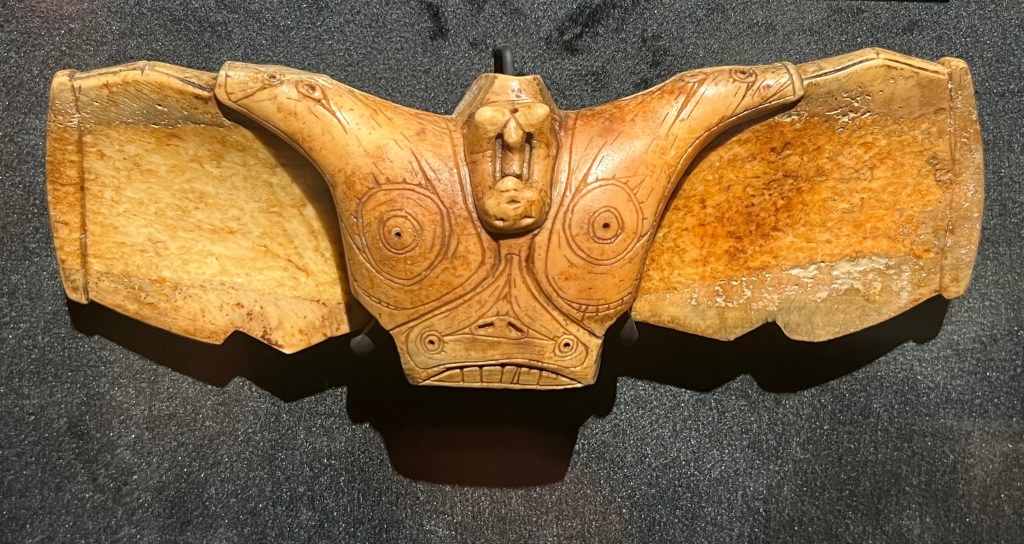
1st millennium A.D.
Bering Strait region, Chukotka, Walrus ivory
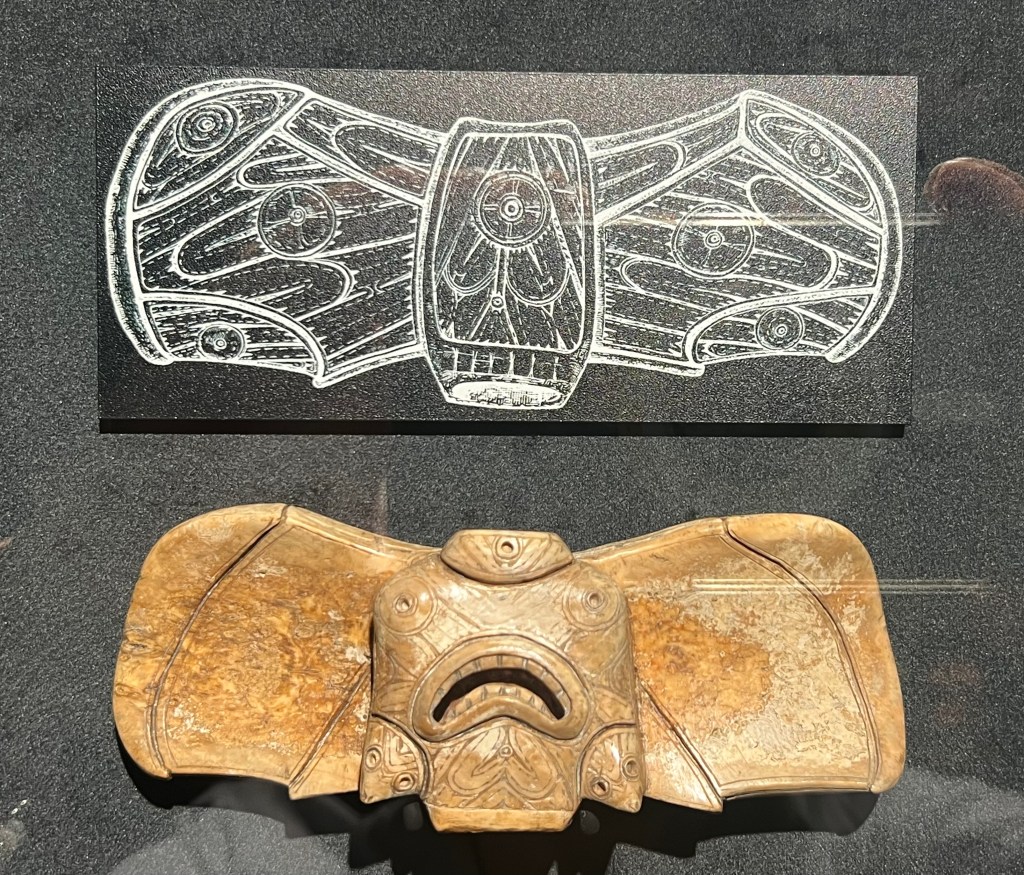
ca. 1st millennium B.C.1 to st millennium A.D.
Bering Strait region, Chukotka, Walrus ivory
Upon researching about the ancient native art represented at the exhibit, I found the following about the walrus ivory art of the indigenous peoples inhabiting the Bering Sea coastal region:
In the distant past – twenty to twenty five thousand years ago – primitive hunters of mammoth, bison and reindeer came to the Chukchi Peninsula and settled both inland and in the Bering Strait coastal region. At that time Alaska and the Chukchi Peninsula were joined by a large isthmus – the continental shelf known as «Bering Land Bridge» or Beringia, the pathway by which Paleo-Indian ancestors travelled from Siberia into North America. By the beginning of the first millennium CE, the coasts of both Chukotka and Alaska and the islands of the Bering Sea were already densely populated by sedentary tribes of whale, walrus, and seal hunters.
Ages passed, both the climate conditions and mainland contours changed. Ten to twelve thousand years ago the isthmus submerged, and a water strait divided Asia and America. Gradually, as a result of human adaptation to the extreme climate of the Far North, a powerful cultural tradition evolved among the marine hunters who inhabited the Bering Sea coast – a unique and distinctive Eskimo culture. The cultural heritage of the ancient indigenous Escimo peoples of the Arctic, including the Inuit (Canada, Greenland, Alaska) and Yupik (Siberia, Alaska) show the moral force of the people, and their ongoing concern with beauty. It is a testament to their capacity to resist the most unfavorable environmental conditions, seeking and finding forces in a deeply spiritual worldview, as well as in common actions, creative work and arts3.
Ancient Eskimo art remains a largely enigmatic phenomenon. It emerges suddenly, at the height of its development, representing a well-established pictorial system with a high level of stylization, difficult for modern understanding. Tradition, passed down from generation to generation, dictated which object should be decorated and how, but we can only understand the logic of this tradition in general terms. Between 100 B.C. and A.D. 100 the art of carving reached its peak. Parallels have often been drawn between artistic heritage of peoples living in the vast territories from the center of Siberia to the southern regions of Alaska, all of which resemble each other stylistically4.
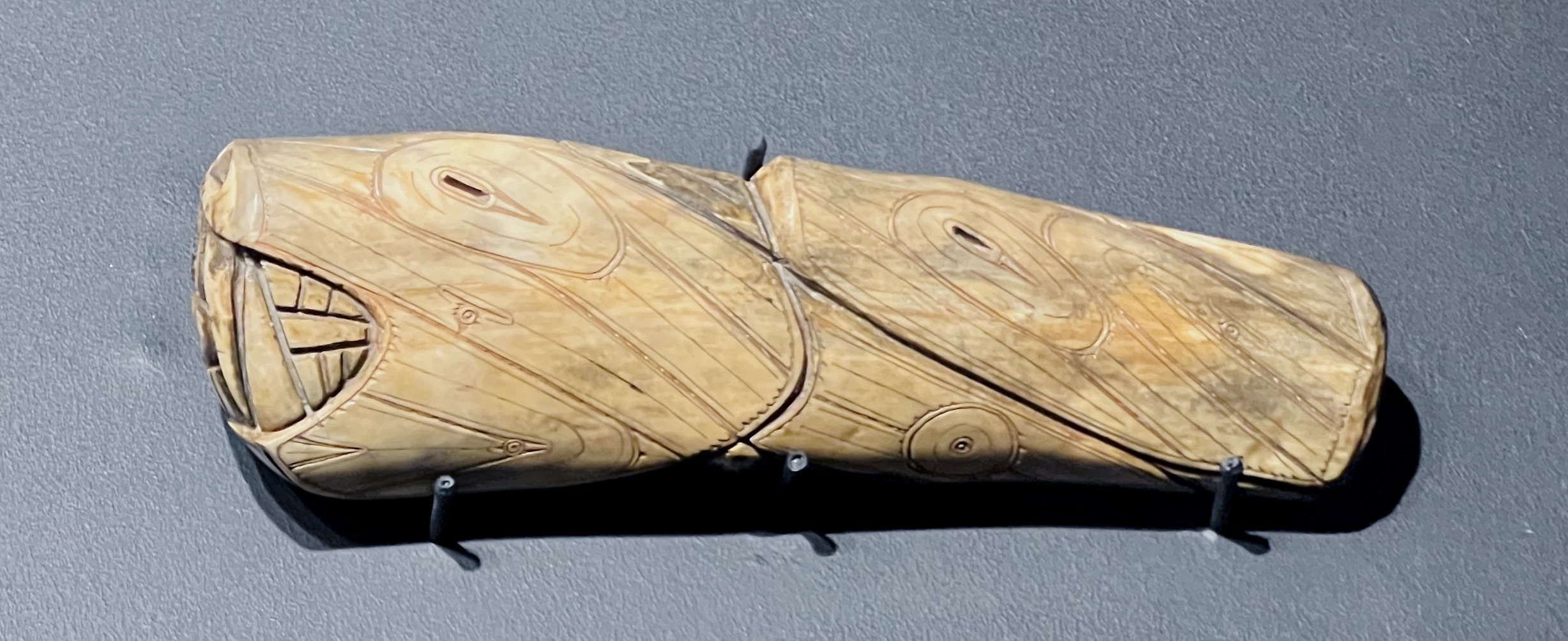
Reality and imagination are close in arctic art, deeply rooted in religious rites and folk tales. Native artists portrayed animals not only as real living beings, but as images of idols or spirits, creatures of old folk tales and mythology.The sculptural figures reflected the deep belief of the arctic maritime hunters in interrelationships of all living beings with one another. They believed that humans could transform themselves into animals, animals could become people, and spirits could appear as animals or humans2.
The parallels between indigenous Arctic bone-carving art of Chukotka and Alaska remind us of common heritage – the unifying force that is stronger than the present day divergencies. At a larger scale, the art of arctic people also did not spring up in a vacuum. Mysterious faces, multiple zoomorphic compositions, graceful designs made with curved lines, characteristic for the ancient Arctic art, reveal some common features with the ancient Chinese civilization art and Hokkaido (Japan’s Ainu indigenous art). As a result of numerous contacts among people, some objects of art created thousands of kilometers away from each other enriched the ancient cultures, weaving a thread of relatedness that is still discoverable today.
While this inevitably triggers more forthcoming research, the harpoons and other remarkable pieces of ancient native art eloquently convey a wealth of wisdom: we all have much more in common than it may seem. We all have common roots. We are fundamentally one – not only among each other but far beyond – one with the Earth, with the Ocean, and with the Sky. What does it take to begin perceiving the relatedness of all natural things? Perhaps, it starts with child-like, vigorous curiosity and a simplest question, many of us have ceased to ask one another…
Thank you:
Metropolitan Museum of Art, The Charles and Valerie Diker Collection of Native American Art
The State Museum of Oriental Art, North Collection of Native Art from Chukotka, Yakutia, and Amur River region.
(1) Nadia Jackinsky-Sethi (Alutiiq/Sugpiaq, Ninilchik Village Tribe) Independent scholar, Homer, Alaska
(2) Joshua L. Reid, Associate Professor of History/American Indian Studies, University of Washington, Seattle
(3) Art of Chukchi Peninsula Peoples. М. Бронштейн, К. Днепровский, Н. Отке, Ю. Широков Научно-популярное издание 1997
(4) The Ancient Escimo Art of Chukotka: the Unique Phenomenon or One of the Numerous Evidences of the Primitive Peoples Creativity? М. Бронштейн 2018
 Beloved Earth. Sketches from the Temple