The art of Nepal reflects exchanges with a succession of northern Indian cultures: Kushan (2nd-4th century), Gupta (4th-6th century), and Pala-Sena (8th-12th century). A powerful stimulus came in the late twelfth century with the collapse of monastic Buddhism in north India, resulting in an influx of monks and religious objects. The Newari artists of the Kathmandu Valley absorbed these influences and transformed them into a uniquely Nepalese style, which in turn had a pervasive influence on Tibetan art.
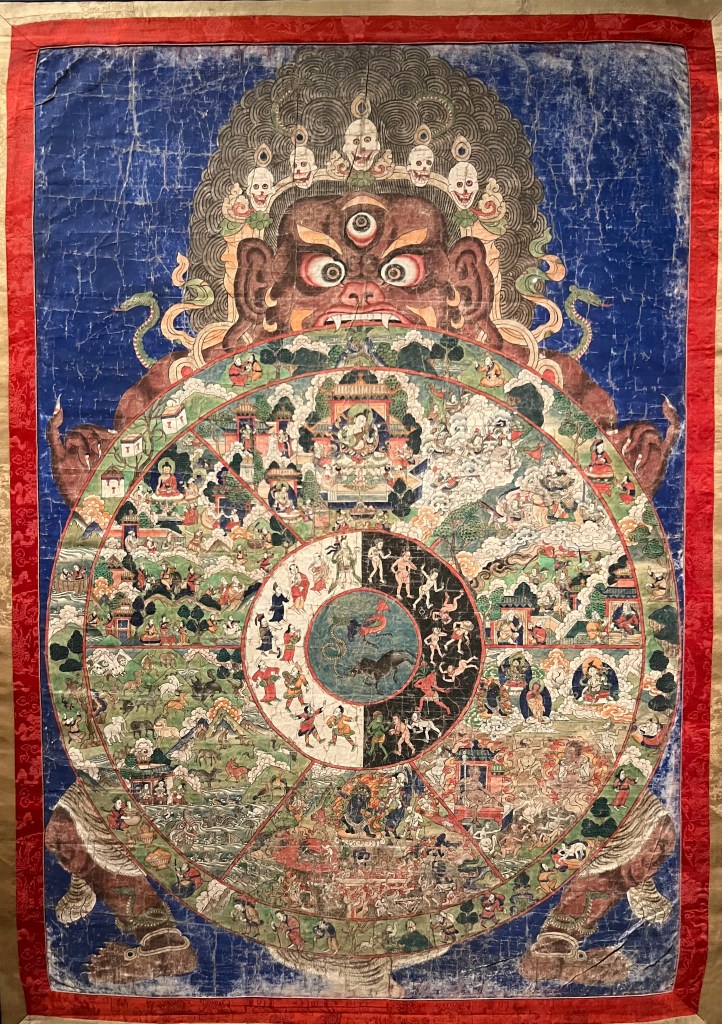
Tibet or Mongolia; 19th century
Pigments on cloth
Buddhist traditions posit that at death the person’s consciousness transitions to an intermediate state called the bardo. For a period of forty-nine days it wanders, propelled by the person’s accumulated positive and negative actions known as karma. Tibetan Buddhist traditions explain that the mind in the bardo faces choices, very much predetermined by the person’s previous actions. The subtle consciousness mind of the deceased experiences visions, which offer an opportunity to awaken from the cycle of being born over and over. However, the task is not easy, nor are the workings of karma simple. Driven by karma’s current, gods can be born in hell, animals reborn as humans, and humans as hungry ghosts or gods.
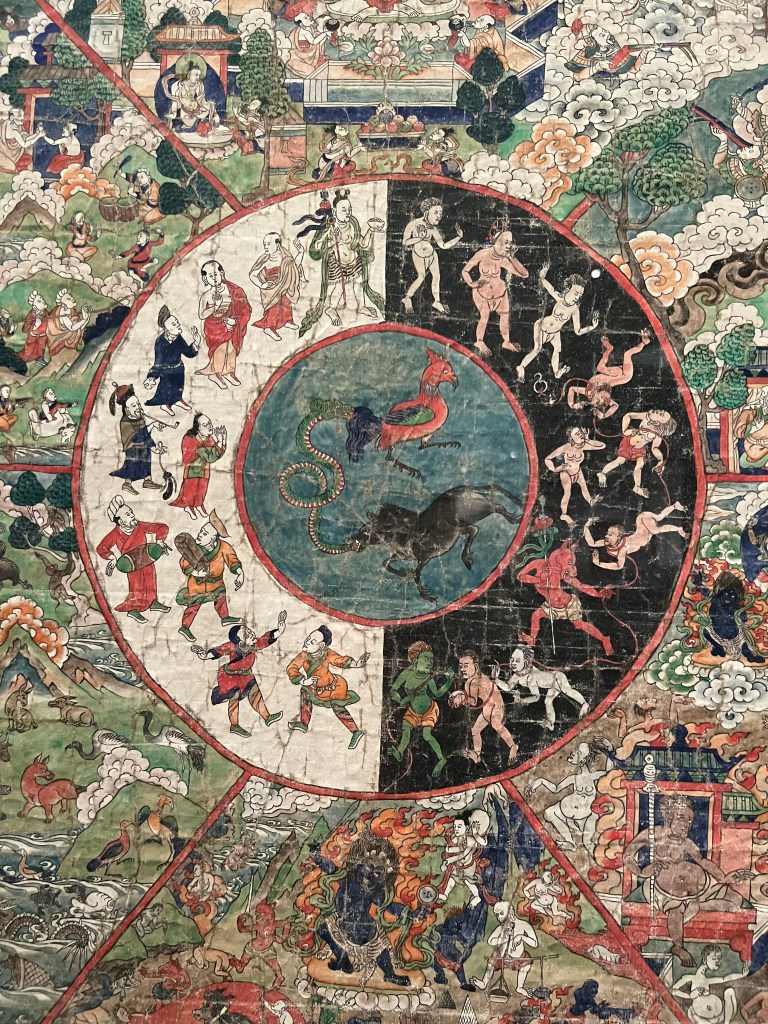
Tibet or Mongolia; 19th century
Pigments on cloth
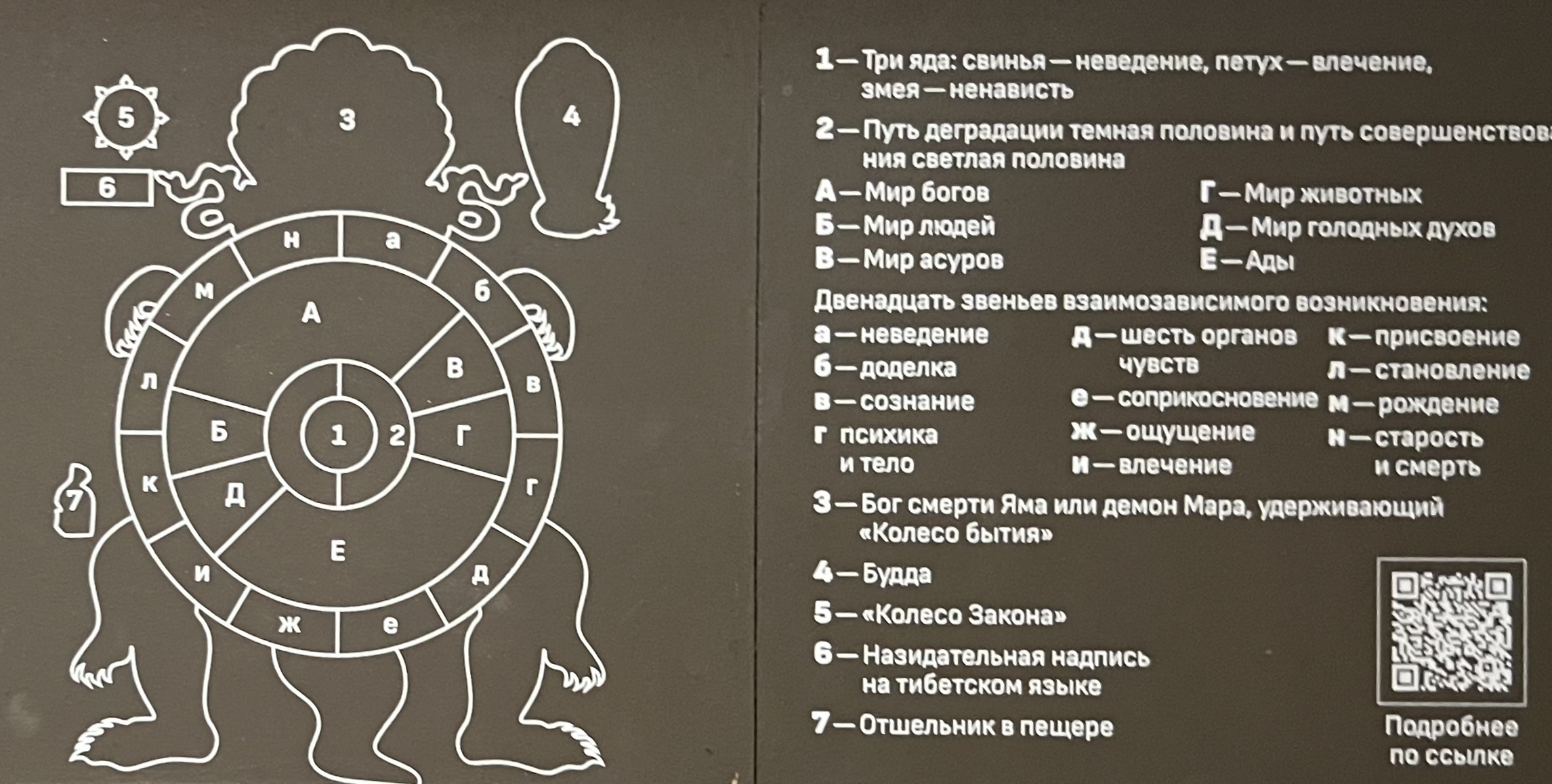
This painting conveys the Buddhist view of the cyclical process of life, death, and rebirth. The Lord of Death, Yama, grips the wheel of existence. Three mental poisons at its hub – attachment (rooster), anger (snake), and ignorance (pig) – propel beings to be born in a perpetual cycle of rebirth in the six realms of existence. As gods and demi-gods (top left), humans (top right), animals (lower left), hungry ghosts (lower right), and hell beings (bottom), beings can move to higher states of consciousness (light) and to afflicted states (dark). Images such as this were painted at entrances to temples to remind monks, nuns, and lay people of the transient nature of life and inspire their work towards future good rebirths and eventual liberation from this cycle.
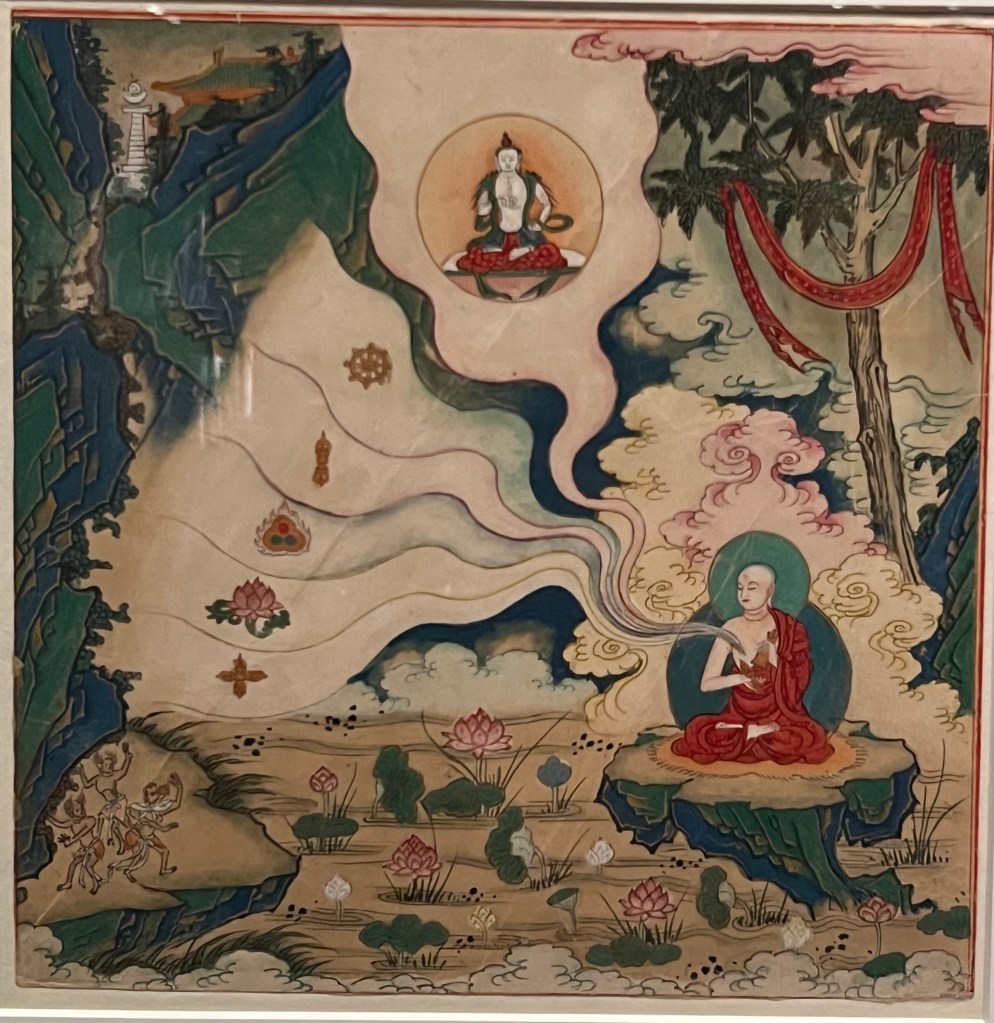
Inner Mongolia; 18th-19th century
Pigments on paper
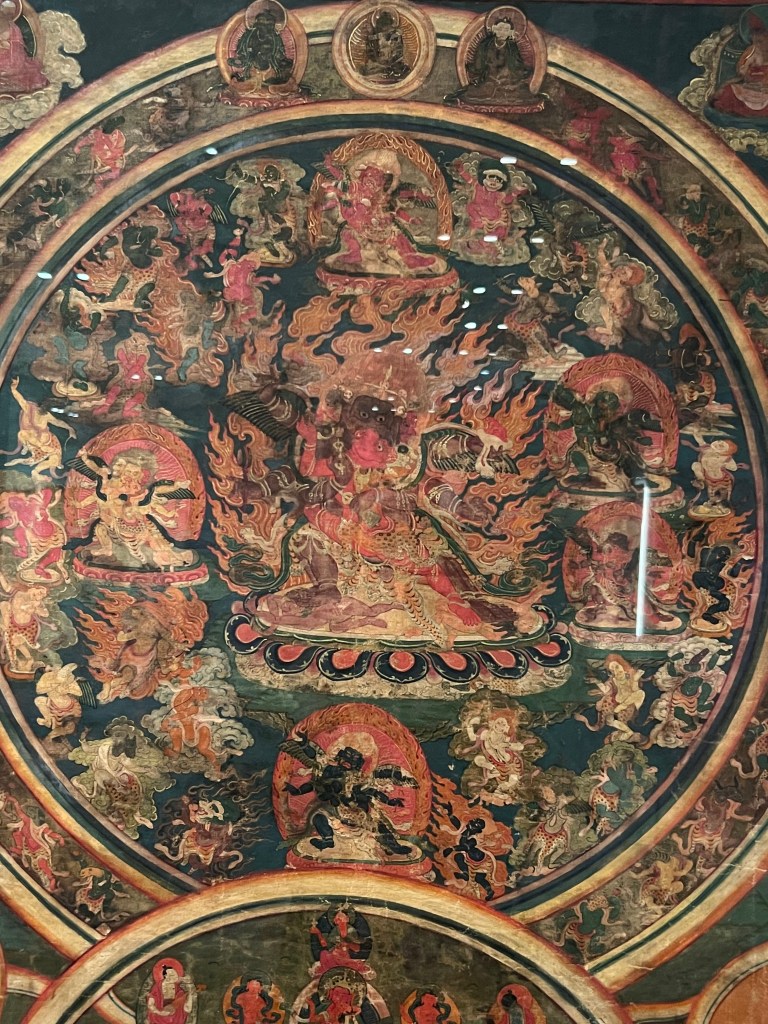
This painting illustrates what a practitioner, who performs the ritual of purification on behalf of the deceased, imagines as part of this practice. Visualizing himself as the deity Vajrasattva, seen above in a golden sphere, he envisions the symbolic implements, shown here as emerging from his ritual gestures or his heart.
These attributes of Five Buddhas of a divine abode, or mandala, represent wisdoms that overcome mental afflictions, purifying the consciousness, and assisting the possibility of a good rebirth.
The images of hungry ghosts, shown in the lower left, reflect the nature of the rituals, which are meant to liberate the deceased, who is yet to be reborn, from unfortunate rebirths.
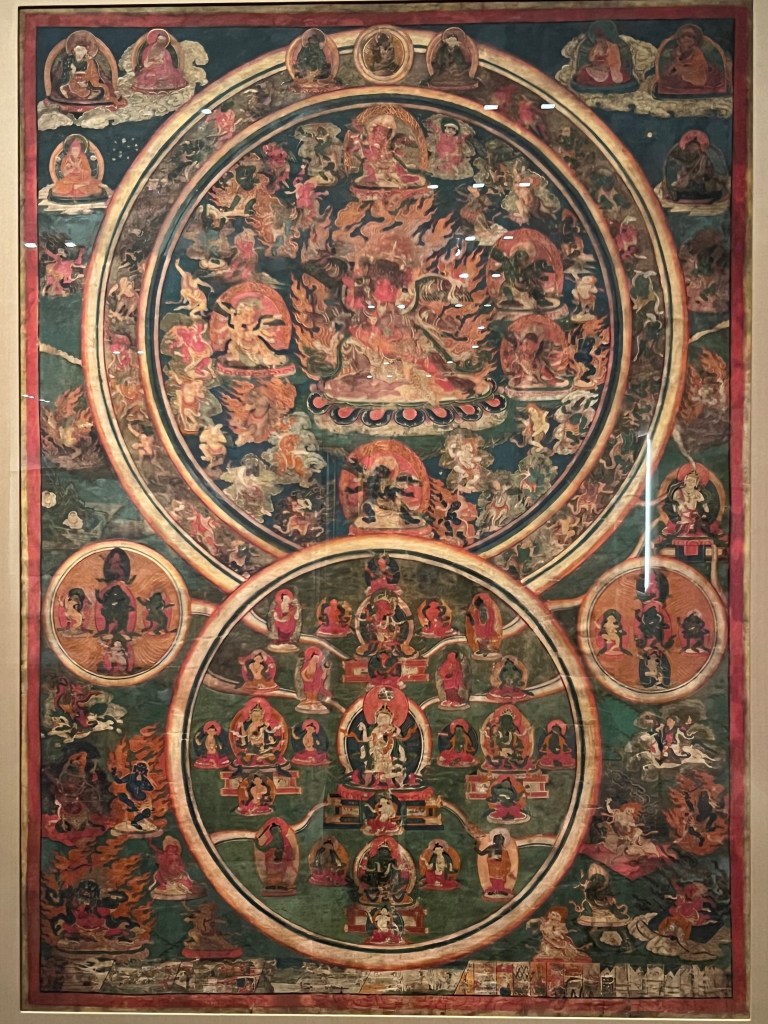
Tibet; 18th century, Pigments on cloth
Buddhists believe death offers an opportunity to attain an awakened state of mind. This painting illustrates the structured experience between death and rebirth-the bardo-as described in the fourteenth-century Buddhist texts known as the Tibetan Book of the Dead. Ritual specialists recite them to the deceased to guide them through the bardo to a future birth.
First, visions of light appear as peaceful deities who encourage the consciousness in transition to realize their true nature and become free. If this opportunity is missed, the mind produces the appearance of wrathful deities. It is harder to recognize their true nature, yet at this stage it is still possible to escape a rebirth in the lower realms of existence. The teachings of the bardo allow a practitioner to prepare for this opportunity.
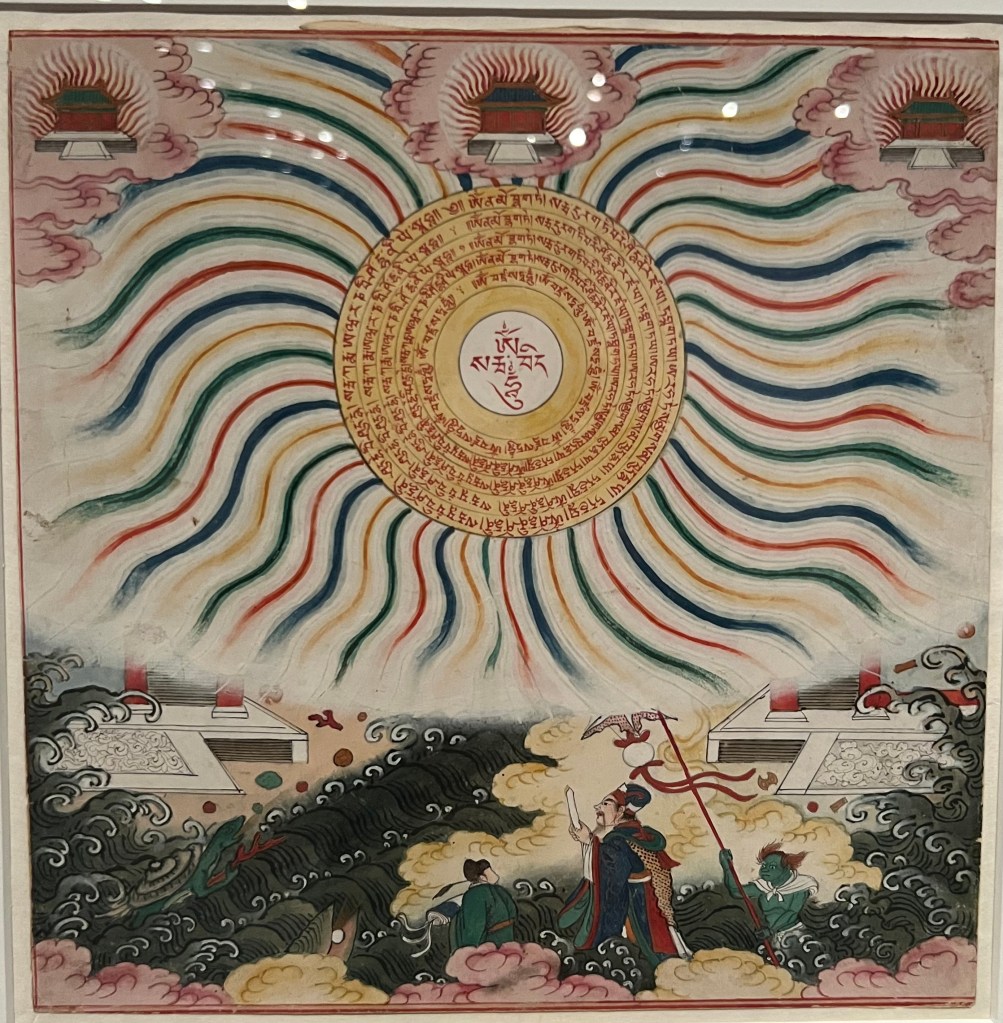
Inner Mongolia; 18th-19th century. Pigments on paper
This painting illustrates what Buddhist ritual practitioners, who act on behalf of the deceased or are training themselves to mentally remove their own negative karma to achieve a good rebirth, visualize as the result of the performed ritual. They imagine that through the recitation of the mantra of the All-Knowing Buddha Vairochana, the sound of which penetrates all realms of existence, the elements of the deity’s abode, or mandala, emerge, as shown here in the form of palaces that emit light. The depiction of the mantra and its sounds is shown as the concentric circles of Tibetan script from which rainbow lights disperse in all directions above the turbulent water of the ocean of existence. Their cleansing power removes obscurations for better rebirth.
Tibet; 18th-19th century
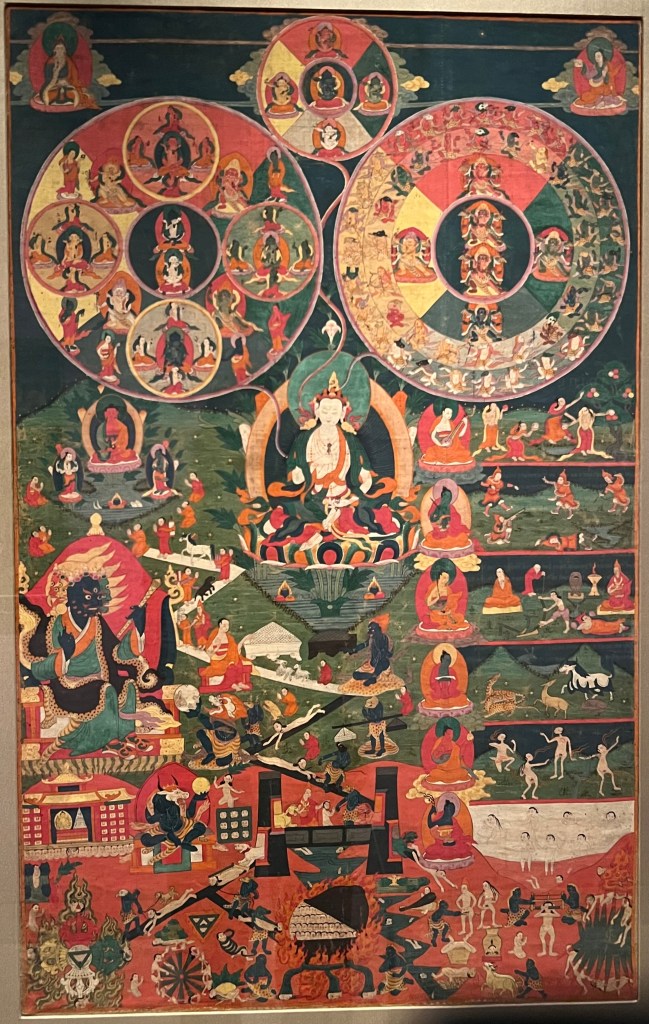
Buddhist traditions maintain that if we are trained to recognize the true nature of our subtle consciousness at the moment of death, we could attain awakening. This image depicts the mind’s experience between death and rebirth-the bardo-as described in the text Liberation upon Hearing in the Intermediate State and imagined by an artist.
First, clear light appears as peaceful deities who encourage the mind to become aware and free.
When negative karma triggers frightful visions, recognizing their nature can help avoid rebirth in the unfortunate realms, if not reach enlightenment. The painting shows all possible outcomes-the six realms of existence as gods, demigods, humans, animals, hungry ghosts, and hell beings. The Lord of Death presides over the judgment of karma which affects the next rebirth.
Tibet or Mongolia; 19th century
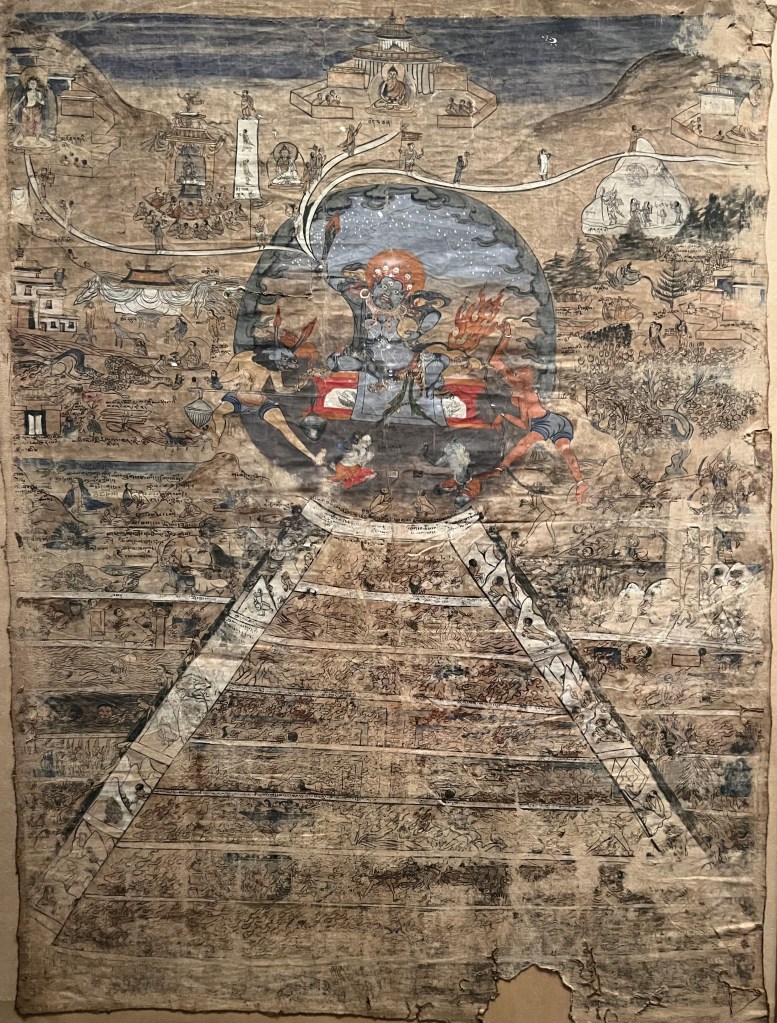
This painting was likely a prop used by itinerant storytellers (manipa) who narrated popular stories as religious teachings intended for the common people. Among such were tales of people who died and returned to the living to tell what they saw in the afterlife. These stories often highlight the suffering of the lower realms of existence that results from non-virtuous behavior, detailing the tortures that await in the hell realms or sufferings of hungry ghosts. This painting has a similar emphasis, with graphic depictions of the various levels of hell taking up half of the composition.
Tibetan Buddhists traditionally celebrated and revered individuals who miraculously returned from being dead. These people recalled what they saw when facing the Lord of Death’s assessment of their karma. The returned from the dead, transformed by their experiences, urge the living to be conscious of the results of their everyday actions. Transformation is also the goal for practitioners of Buddhist tantra who work to transform their consciousness.
They also act on behalf of the deceased and perform rituals to purify their negative karma and ensure good rebirths. Among the most desired rebirths is to be born in the presence of a buddha, in a Pure Realm, the place that a buddha creates and inhabits. Devotees pray to be born in such pure realms, to be in the presence of the buddhas and free from the cycle of rebirths.
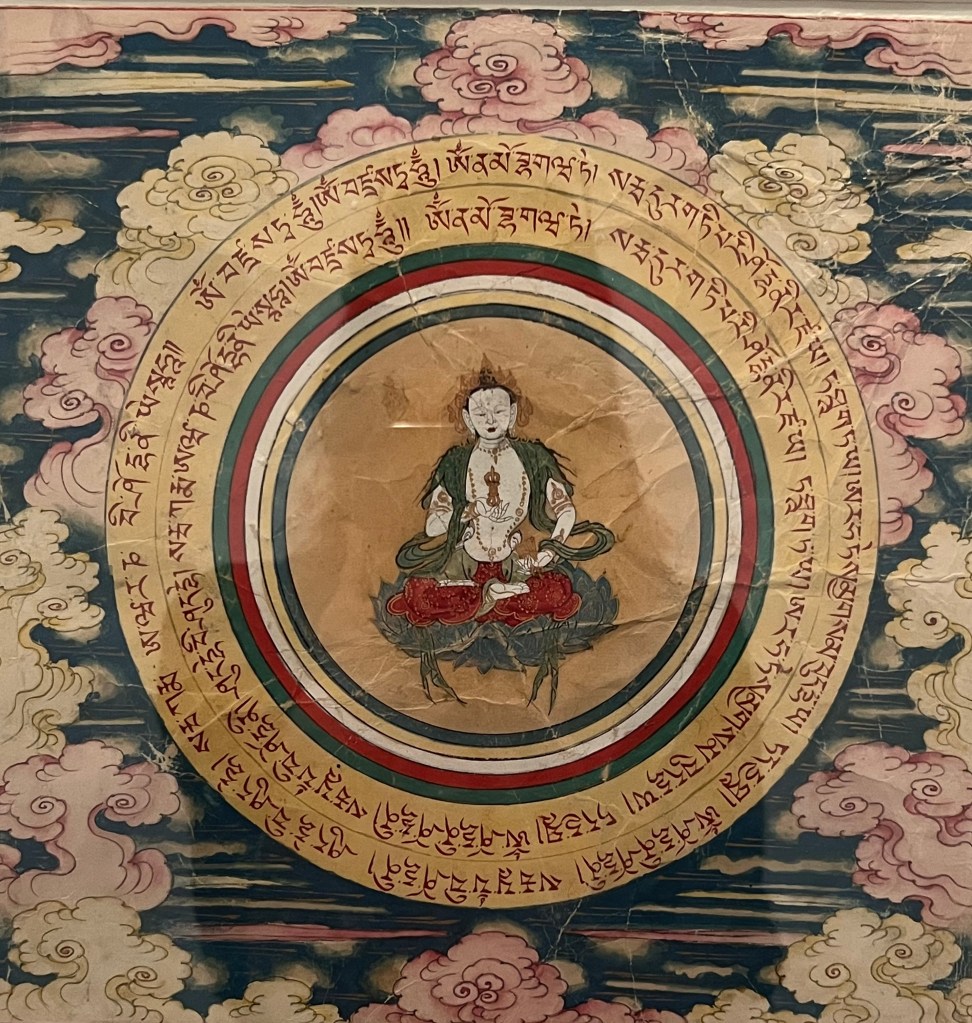
Purifying Mantra
Inner Mongolia; 18th-19th century
This painting illustrates what Buddhist ritual practitioners, who act on behalf of the deceased or are training themselves to transform their mind and the ordinary perception of reality, visualize during their meditation and ritual.
Practitioners contemplate on the nature of reality being impermanent and empty of inherent or true existence. They also meditate on the enlightened characteristics of the deity Vajrasattva and visualize themselves acquiring the realization of the true nature of reality. With multiple recitations of the purifying mantra of Vajrasattva, practitioners aim to cleanse mental obscurations of the deceased as well as any mistakes they might have made during the performance of the ritual and visualization.
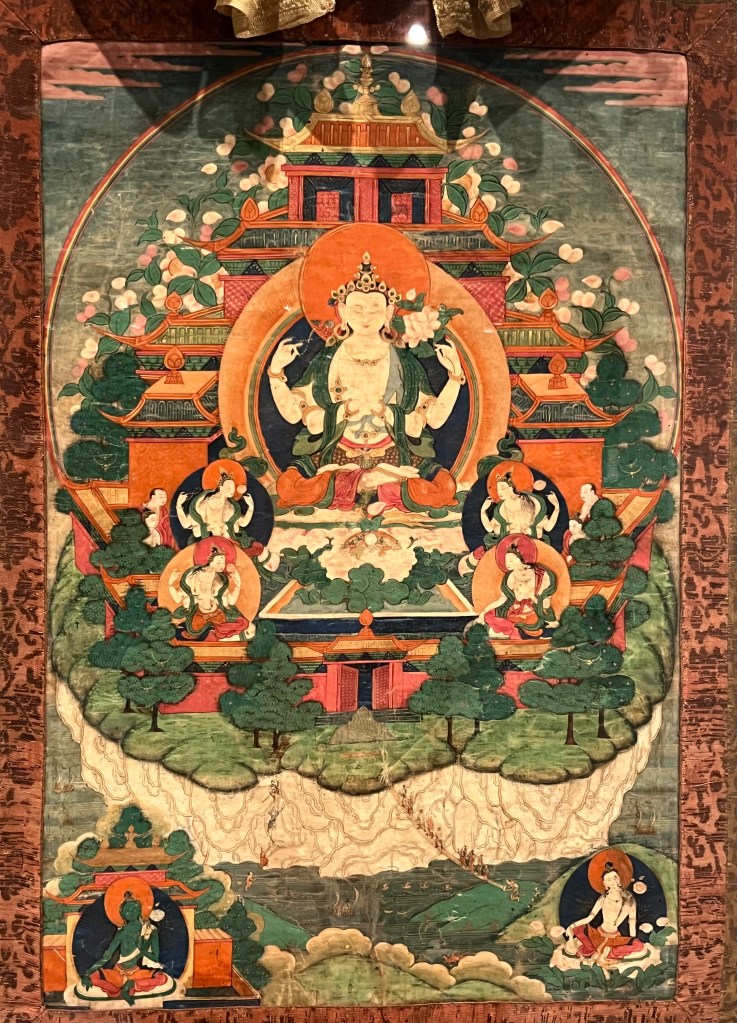
Tibet; late 18th-early 19th century
This painting depicts the mountainous island Potala – the realm of Avalokiteshvara, the deity of compassion – where devotees wish to be reborn. The exceptional composition and iconography of this painting visually and literally interpret Buddhist texts about this realm. Avalokiteshvara is seated within his palace among the deities of his retinue.
The gate of the enclosure is open, welcoming the believers to enter. In front of it is a self-arisen image of a seated Avalokiteshvara discernible in a rock, a natural marker of the site. The two deities in the lower corners of the painting, Green Tara (left) and Padmapani (right), watch over a stream of people on a rope bridge and a scroll bridge crossing to the island over the ocean, which is symbolic of the ocean of suffering.
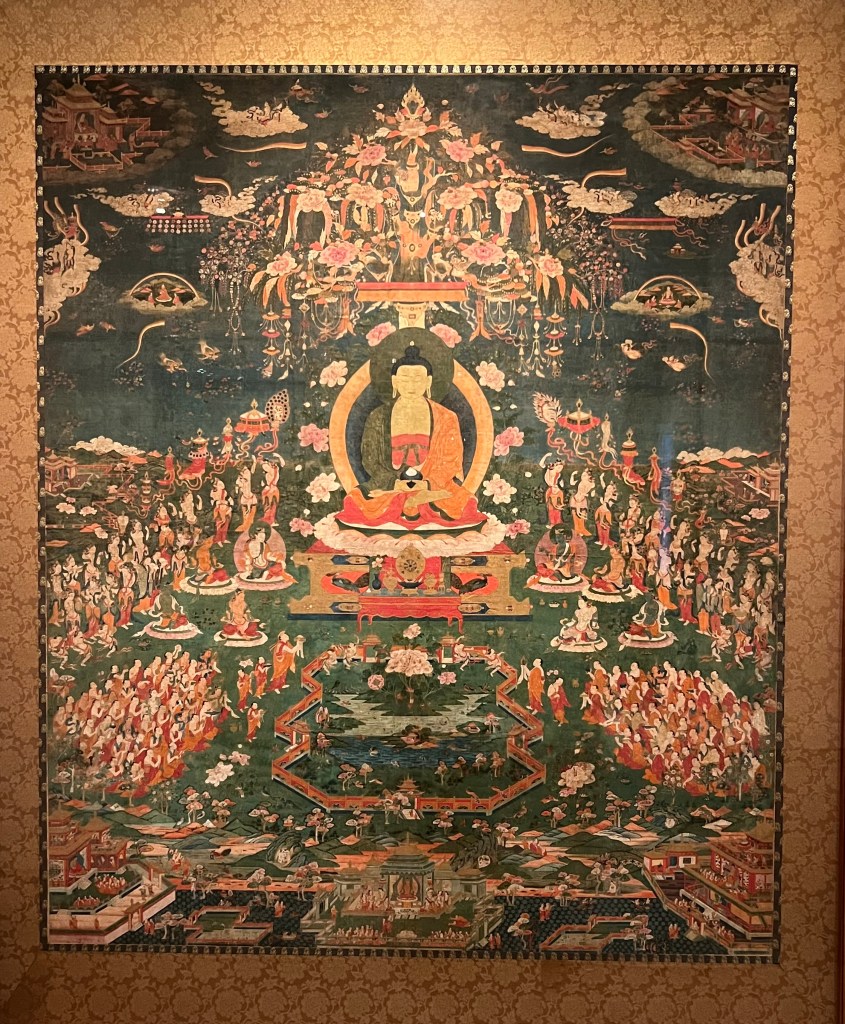
Tibet; ca. 1700
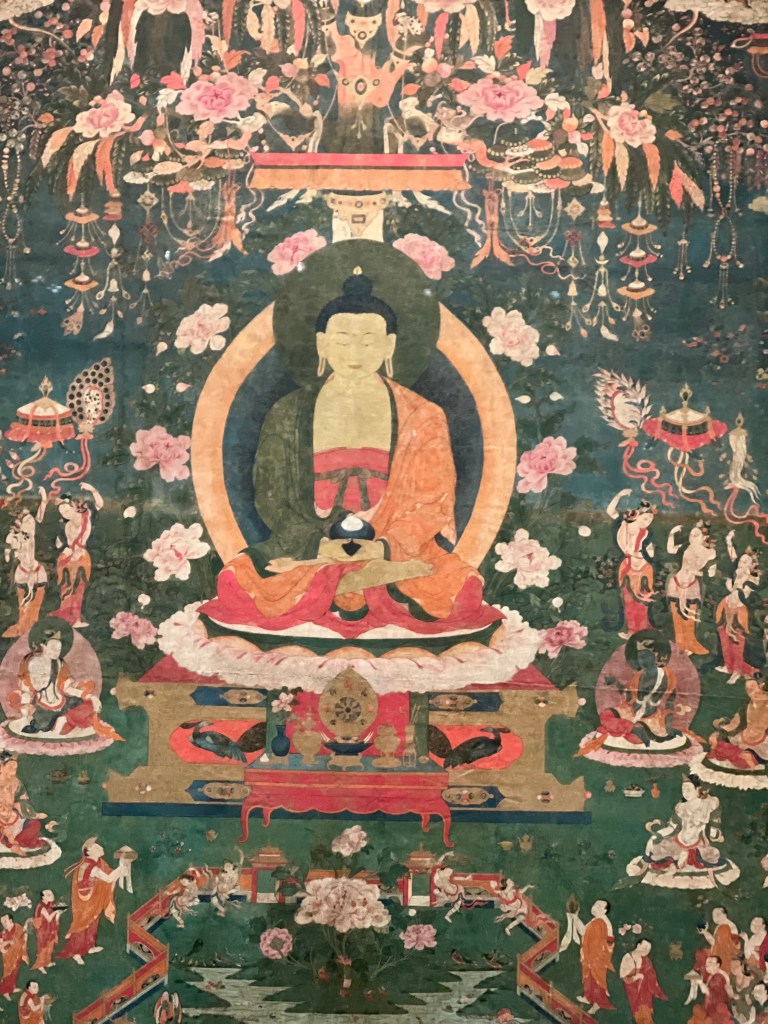
This large intricate painting is an exceptional example of special Tibetan Buddhist images that visualize realms where there is no suffering. Such Pure Realm depictions contain pleasant vistas full of flowers, streams, and beautiful palaces. Artists delight in elaborating such heavenly scapes. Many Buddhist texts describe the Pure Realms of the buddhas, and Sukhavati is considered among the best possible destinations to be reborn. Beings are born there from lotuses and can remain in the presence of the Buddha of Infinite Light, Amitabha, or progress swiftly on their path to awakening. The scenes show groups of fortunate beings listening to Amitabha and enjoying the realm. Devotees believe that they will reach this exalted realm through fervent prayer to this buddha.
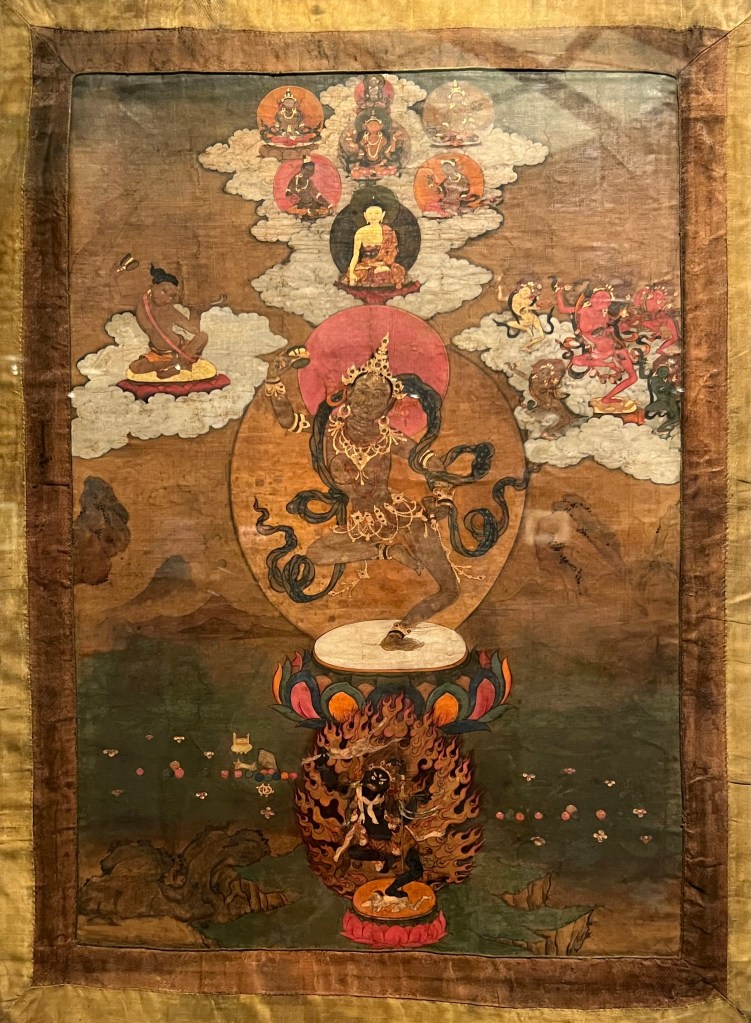
Kham province, eastern Tibet; 19th century
Machik Labrdon, a woman famous for her mastery of the tantric practice known as “cutting through ego” (chod), is shown adorned in bone ornaments, dancing to the sounds of her drum (damaru) and the bell she holds.
To her right are dakinis, goddesses who walk the skies, dancing with her. To her left, a tantric master, possibly Machik’s teacher, is blowing into a leg bone trumpet. A personification of the Perfection of Wisdom, the deity Prajnaparamita is above her among the buddhas, symbolizing that the realization of the empty nature of reality is what frees one from the attachment to self, the root cause of all suffering. Chod practitioners intentionally visualize in their mind’s eye their own bodies as offerings to the gods and spirits.
Transformation as a concept has been used in all cultures to denote fundamental change. In Buddhist traditions, transformation can be described as the process during which the practitioner realizes the nature of reality. This transformation of consciousness, or awakening, frees the mind from the suffering of life’s cyclical existence
of being born, dying, and being reborn. Tantric practitioners use transformative practices, many of which are quite unconventional, to facilitate the achievement of this goal. Some tantric practices focus on death and conquering it through transformation.
Buddhist practitioners who engage in the practice of “cutting the ego” (chod) use implements such as this during their meditation and rituals. These yogis visualize, while reciting verses and mantras of the tantric ritual, that they dismantle their ego. They blow the trumpet to summon spirits and other beings inhabiting the charnel grounds and offer them their visualized cut-up body as an offering. They also rhythmically rotate the drum to beat it at appropriate moments of their ritual, which aids in transforming their perceptions.
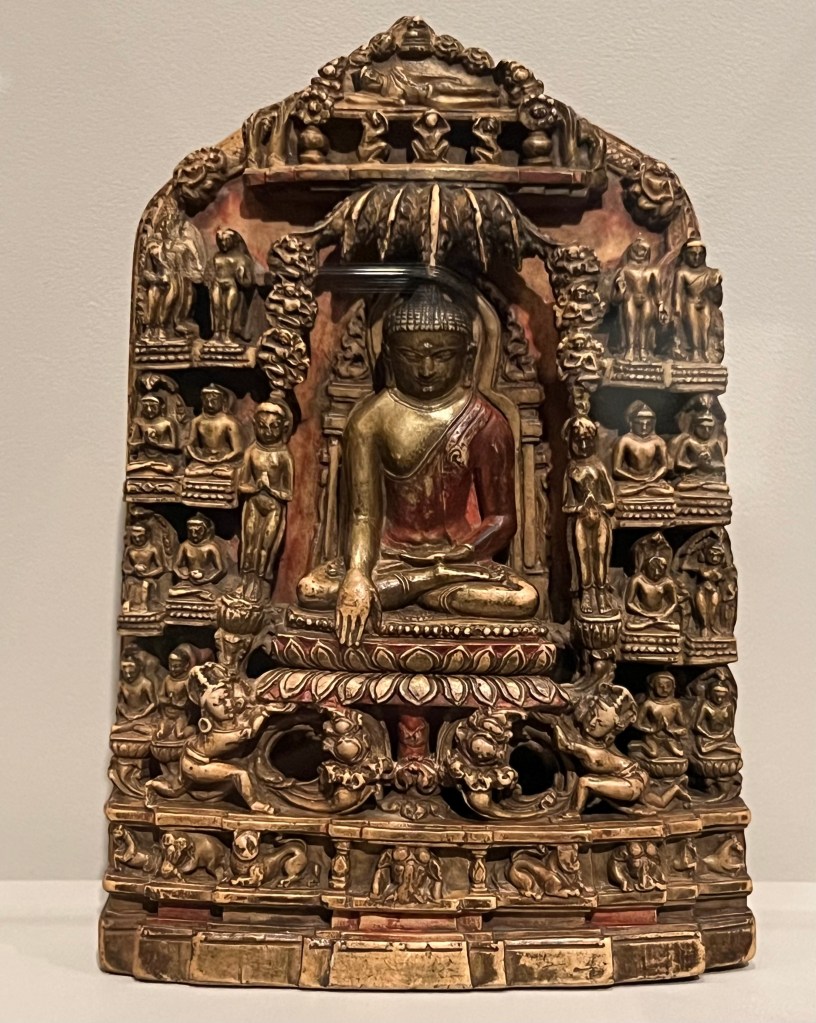
Northeastern India; 12th century Andagu stone with pigments
At the center of this small upright carved stone slab, or stele, the Buddha touches the ground under a tree, a reference to the moment of his awakening. Scenes of his life surround this central image.
For early Tibetan Buddhists, the northeastern Indian village of Bodhgaya, the place of the Buddha’s awakening, was an important pilgrimage site. Some pilgrims returned to Tibet with small stone steles dedicated to the Buddha’s life, like this one, as souvenirs.
The composition of these steles is similar to those seen in early Tibetan paintings. The physical appearance of the Buddha, featuring a disproportionally short and thick neck, is a direct reference to the main sculpture that occupied the temple at Bodhgaya, as seen seated in the adjacent model of the Mahabodhi Temple, from about the eleventh to the thirteenth century.
Tibetan Buddhism originated in texts and practices adopted from northern India. Northeastern India, immediately to the south of Tibet, is the birthplace of Buddhism and home to the main pilgrimage sites celebrating the Buddha’s life. This region and Kashmir to the northwest were major artistic centers, and the work produced there was well known and collected in Tibet. Broadly speaking, Tibetan art inherited its proportions and much of its symbolism from Indian precedents. Tibetans have retrospectively categorized their art based on visual models from these two areas. Tibetan art following the traditions of northeastern India is called the Eastern Indian Style (Sharri or Shar luk). Tibetan art modeled on the traditions of Kashmir and the Western Himalayas is called the Artistic Tradition of Kashmir (Kache luk).
Buddhist and Hindu traditions spread side by side in the same communities in India and Nepal, and some of the deities in the two religions are associated with similar myths. In parts of the Himalayas several deities and their images particularly important to local communities are celebrated by both Hindus and Buddhists at annual festivals and in daily rituals.
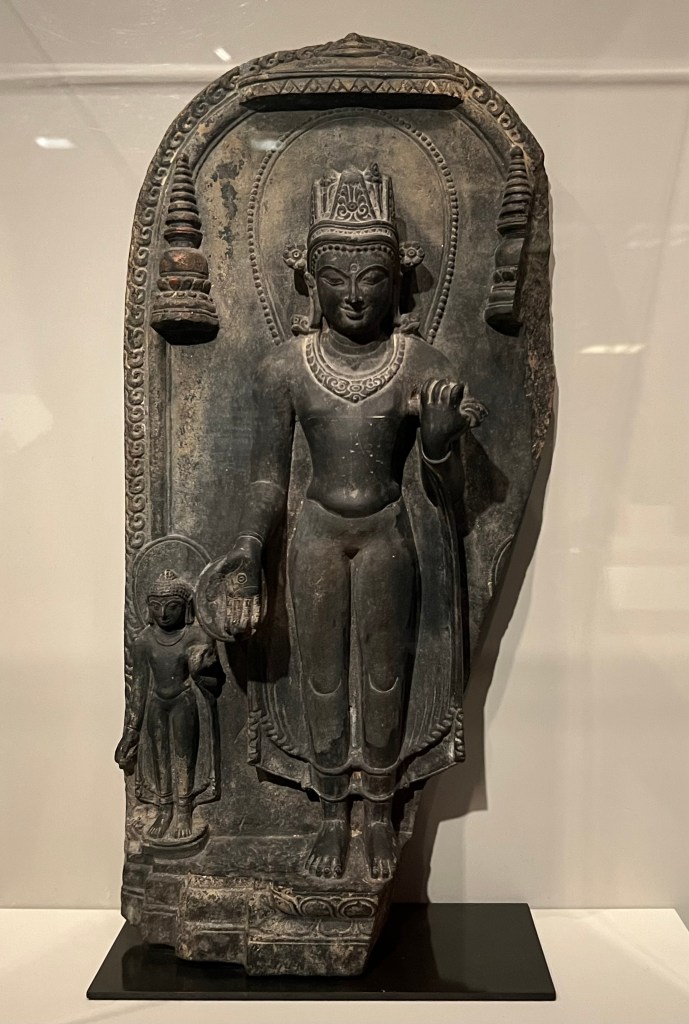
Northeastern India; Pala period (750-1174), 10th century. Stone
For early Tibetan Buddhists the holy sites of northeastern India were important pilgrimage sites. This sculpture is modeled after images of the Buddha located in and around Bodhgaya, the place of the Buddha’s awakening (see adjacent model of the Mahabodhi Temple). In this region Tibetans encountered images of the Buddha standing in a rigid pose, facing forward, with his legs together and clothing clinging to his body.
Many Buddha depictions of this period are crowned and bejeweled, a characteristic that became popular beginning in the seventh century and is occasionally quoted in early Tibetan painting.
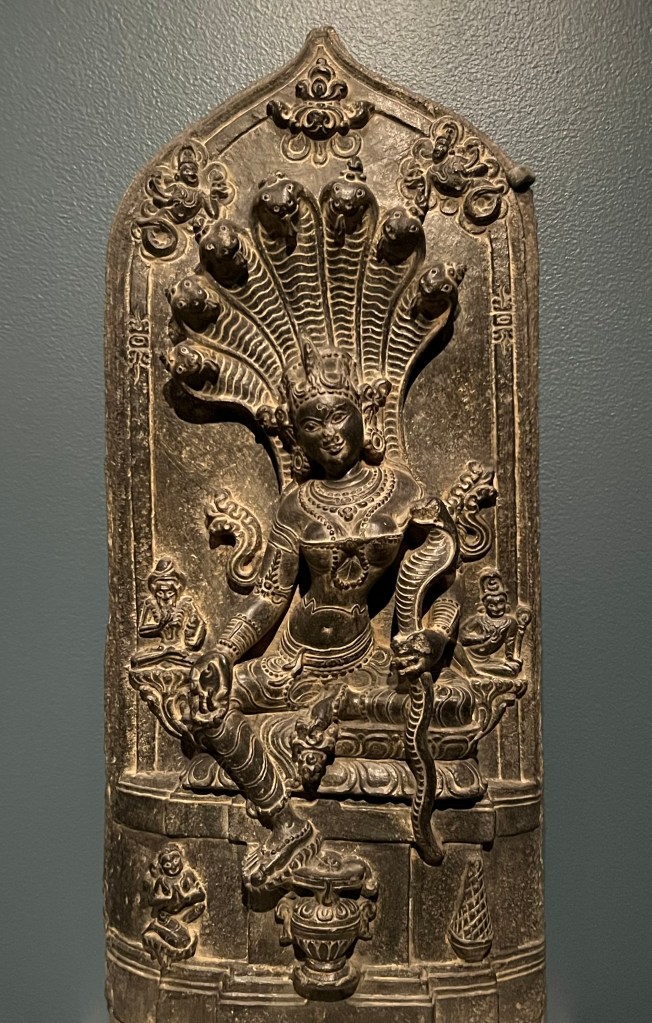
Northeastern India; ca. 12th century
This masterfully carved stone stele depicts the Hindu snake goddess Manasa, who is venerated in Bengal in northeastern India. She is worshiped primarily for her ability to prevent and cure snakebites, a power reflected visually in her hood of seven snakes and the snake she holds in her left hand. She is also believed to bestow agricultural prosperity and fertility, here represented by the fruit in her right hand and the vase underneath her foot.
The same artisans often made objects for different religious traditions, so Hindu and Buddhist images often share stylistic similarities. For example, the imagery for the Hindu goddess Manasa is comparable to depictions of the Buddhist deity Tara, as seen in the adjacent Tibetan sculpture, including the shape and position of the body and jewelry.
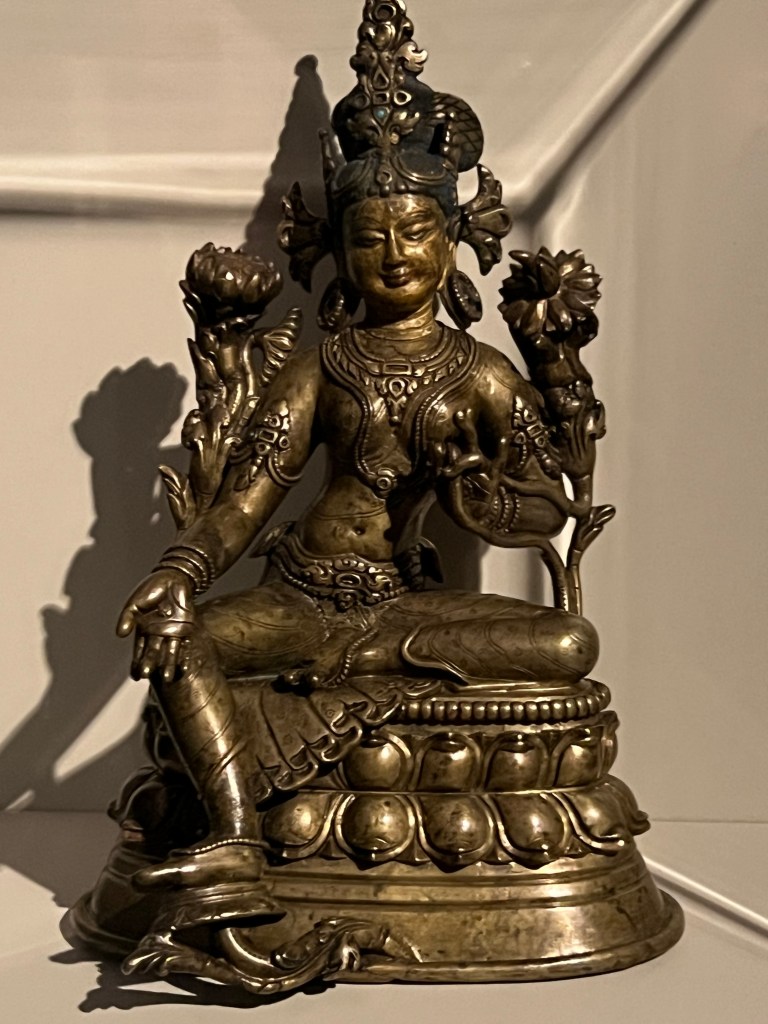
Central Tibet; 14th century. Gilt copper alloy
This bronze of the Buddhist deity Green Tara represents early Tibetan aesthetics and metal sculpture at its best.
The overall composition of this sculpture and the elegant sway of the body are based on Indic examples, as are details like the hair with a knot on one side covered by a net and the transparent scarf crossing the chest and forming a loop on the left shoulder. There are many similarities with the adjacent northeastern Indian stone sculpture of the Hindu goddess Manasa, such as the aesthetic ideal of the female form, the position of the hands and feet, the jewelry, clothing, and lotus throne, even the fall of the drapery.
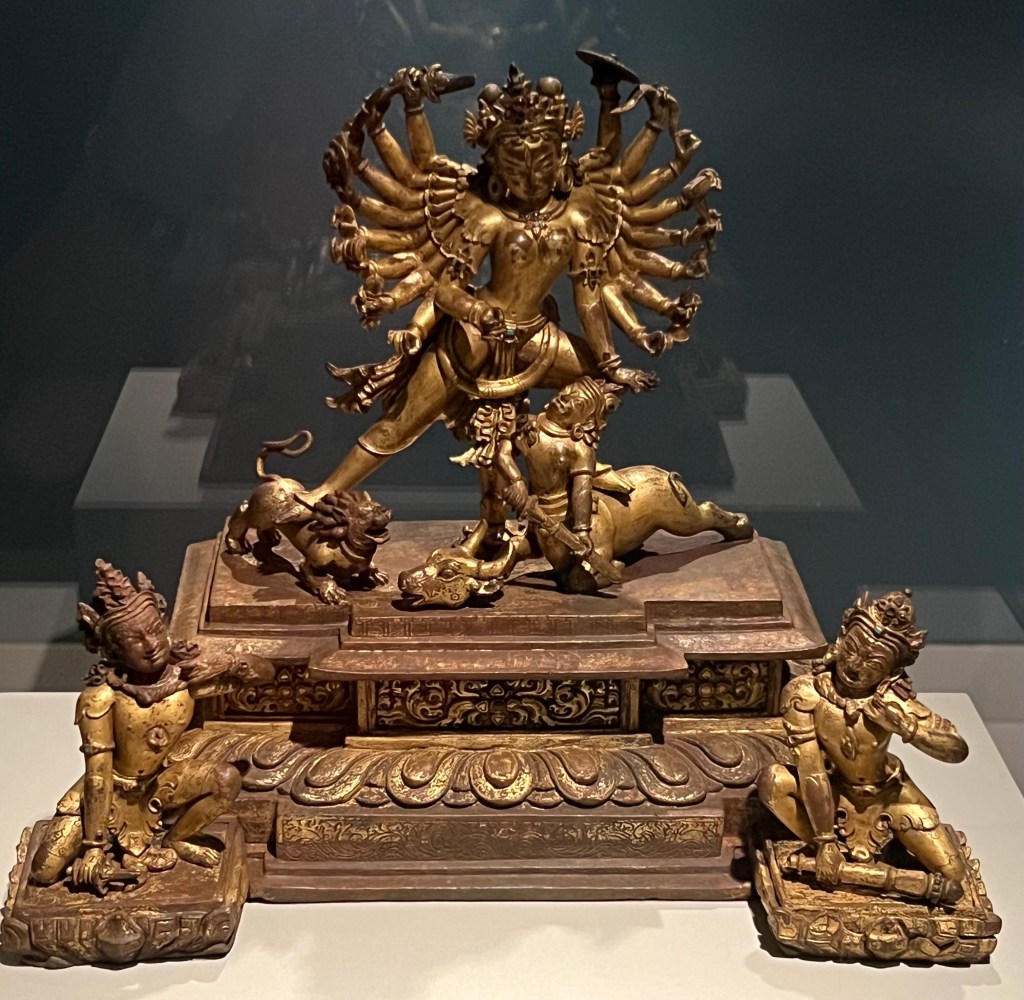
Nepal; 13th century. Gilt copper alloy
The Hindu goddess Durga assembled the weapons of all the gods and overcame the demigod Mahisha, who endangered the order of the world. She is represented here at the moment of her victory.
Having chopped off the head of a bull, Durga pulls the body of the demigod by the hair from the animal and stabs him before he can even draw his sword. This outstanding sculpture perfectly combines the dynamic with the static. The goddess’s powerful stance and fan of arms are balanced by her otherwise delicate features and calm expression. Her fan of arms is magnificently rendered in three-dimensions, the positioning of multiple arms to her arched back gives the appearance of two arms captured in different positions along an arc, as if conveying motion.
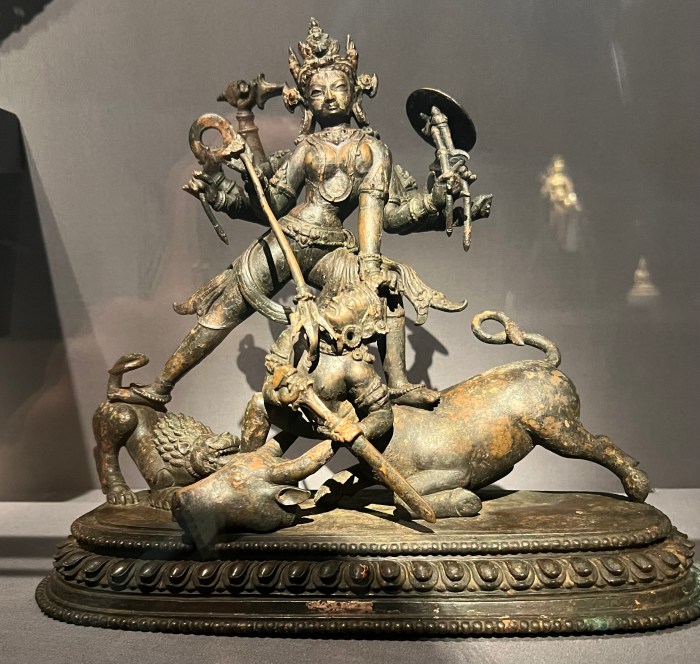
Nepal, 14th century.
Durga, the supreme goddess, is armed with magical weapons lent to her by an assembly of male gods. Here, she is seen transfixing the buffalo demon Mahisha with Shiva’s trident (trisula). The sculptor’s ability to evoke the energy and vitality of the enraged goddess, wielding her weapons in a frenzy of destruction, ranks this work among the finest versions depicting this subject.
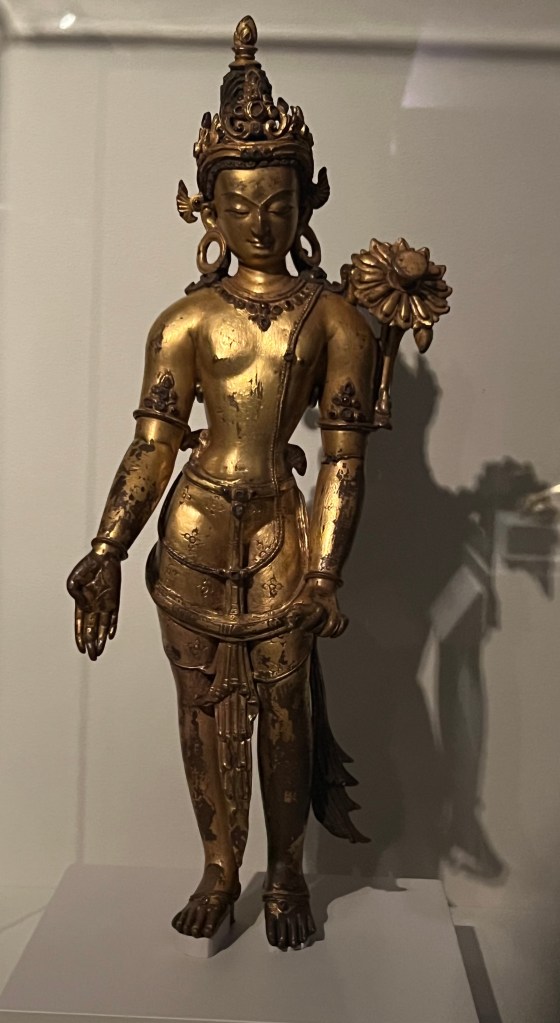
Nepal; 13th-14th century. Gilt copper alloy with semiprecious stone inlay
Avalokiteshvara is one of the most popular deities in Nepal, where 108 forms of him are known. In his simplest form, extending his right hand in the gesture of giving and holding the stalk of a lotus (now broken) in his left, he is often called Padmapani, or Lotus-in-Hand.
Metal sculpture figures from Nepal share a number of characteristic features, such as a gentle smile and hawk-like nose. This sculpture is remarkable for its simplicity of line, graceful proportions, and elegant jewelry. The subtle modeling of the body contrasts with the voluminous and pointed ends of the bodhisattva’s clothing and the large, slim-petaled lotus blossom over his shoulder. The reddish tone of the metal, seen where the gilding has worn away, indicates a high copper content, which is typical of Nepalese sculpture.
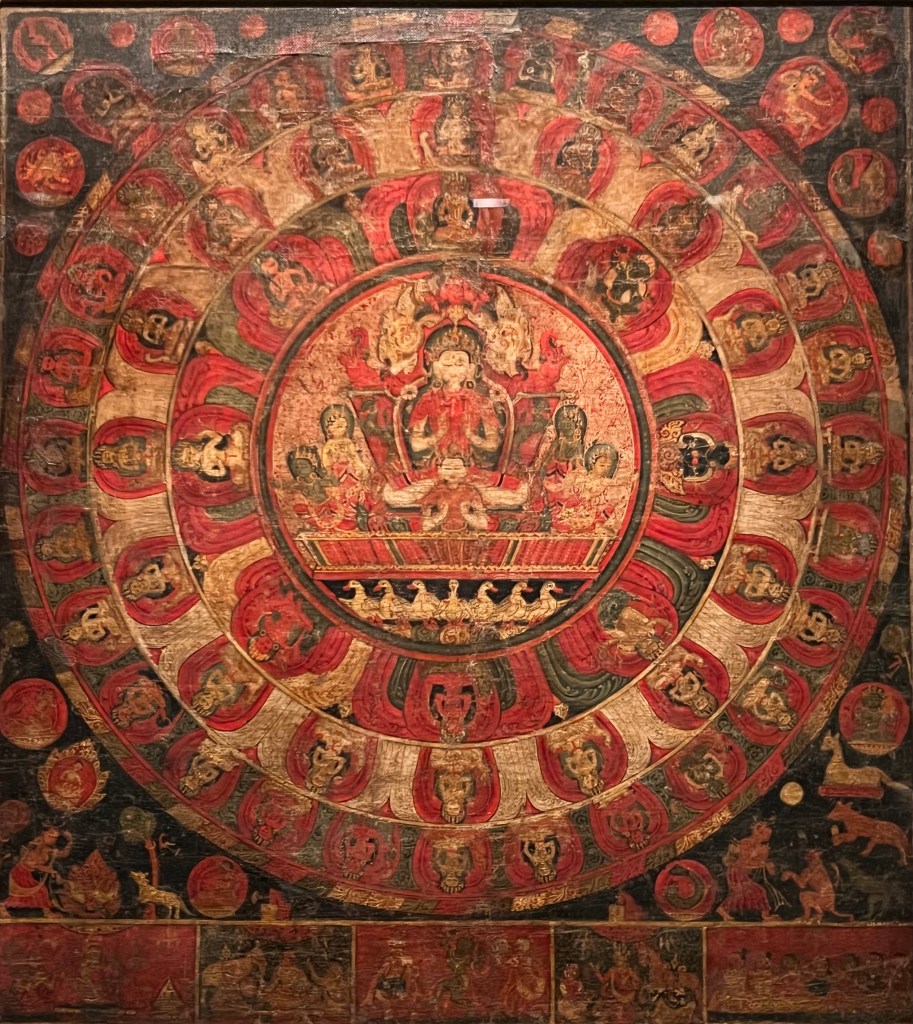
Nepal; ca. 1500
In this mandala of Chandra, the personification of the moon, the deities are not depicted residing in a palace, as is typical of other mandalas. Instead Chandra sits at center on an elaborate chariot pulled by geese with a complex arch framing his head. The mandala is set against a black background with the corners symmetrically distributed.
Stylistically the Buddhist paintings of Nepal and Tibet are closely related, but there are some features that are characteristically Nepalese. One such cultural concern reflected here is the expansive depiction of patronage, ritual action, and veneration at the bottom of the painting.
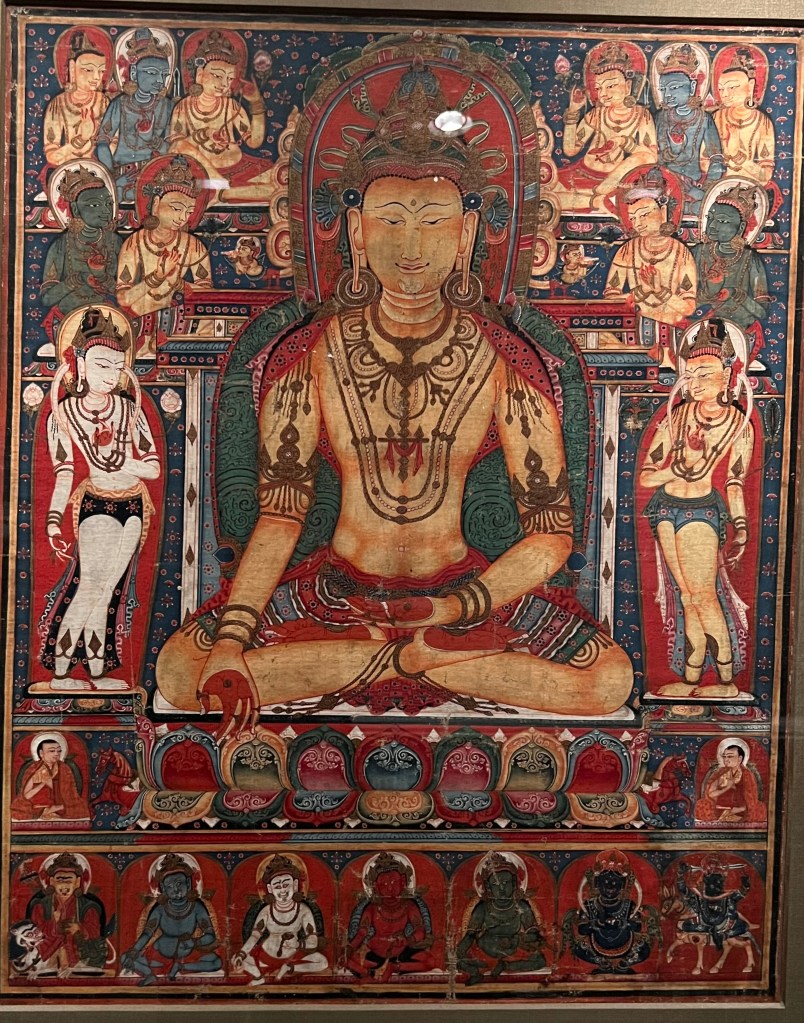
Tibet; early to mid-14th century
Ratnasambhava, the buddha that presides over the southern direction, is one of the Buddhas of the Five Families. Each Buddha Family is associated with a cardinal direction. This painting is from a set of five, each depicting one of these buddhas. Ratnasambhava represents the jewel family, associated with wealth, and five forms of the wealth deity Jambhala are shown along the bottom of the painting.
Early Tibetan paintings are strictly organized with each figure sized and placed in a way that reflects his or her relative importance. For instance, Ratnasambhava is the subject of the painting, so he is the largest figure and located at the center. He is richly bejeweled, with all of his jewelry raised and gilded, as is typical of Tibetan paintings of this subject and period. The bold color scheme, strong shading, and abundance of decorative details separate this work from earlier examples of this theme.
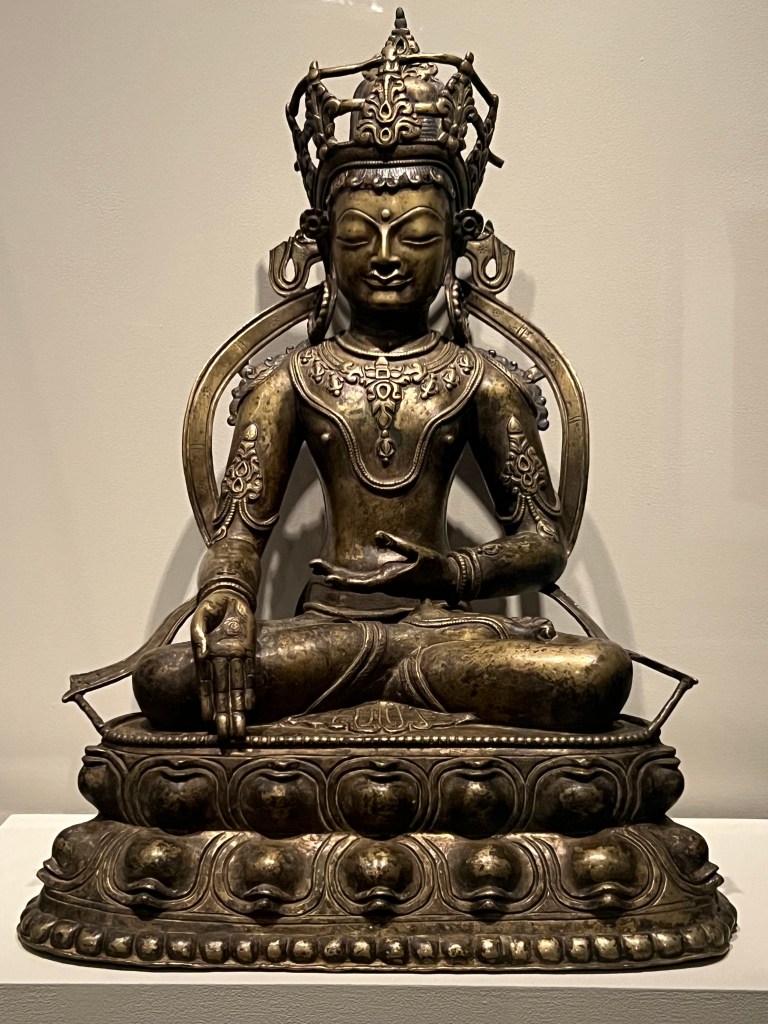
Central Tibet; 13th century
In early central Tibetan art, of which this sculpture is a fine example, figures have massive heads and rather large hands and feet. The deities have a high hair knot at the back of the head, crowns with large points set apart from each other, ribbons and circular earrings, and strands of hair falling on their shoulders. They sit on a double-lotus throne with plain, fleshy petals in elegant poses with minimal sense of movement. Their large jewelry is graceful but has little variation.
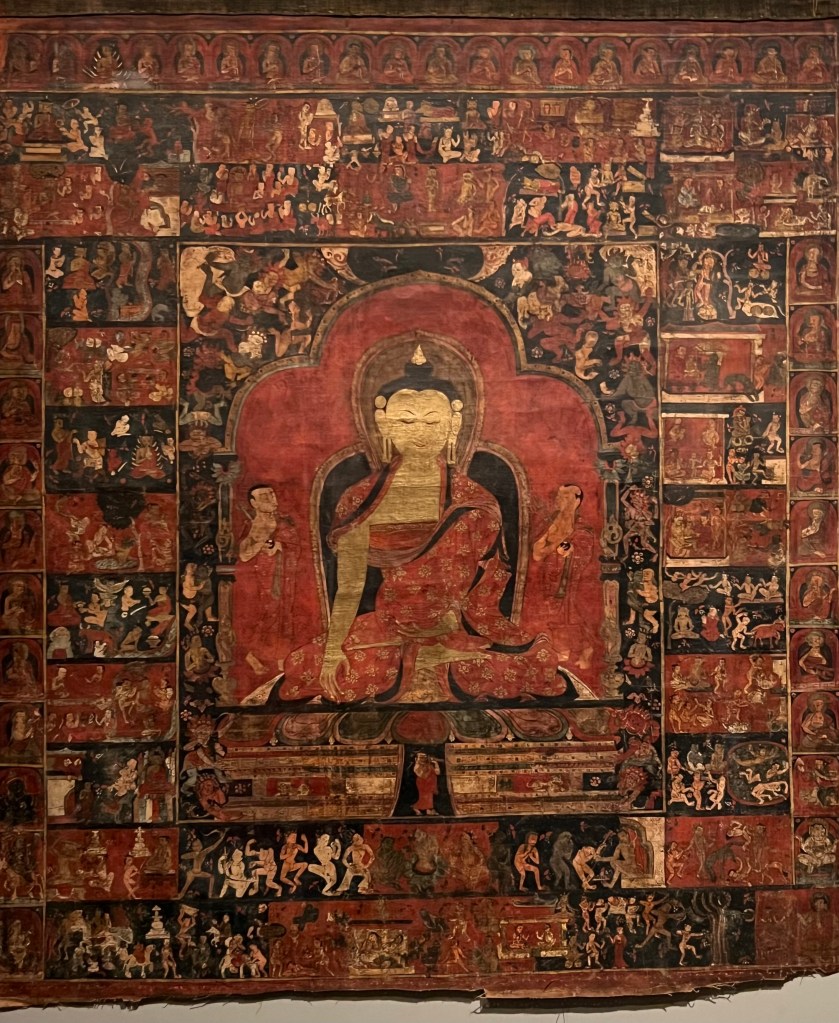
Tsang region, central Tibet; second half of the 14th century
This detailed representation of the Buddha’s life is based on a composition derived from northeastern India. At the center of the painting is a depiction of the Buddha’s awakening, with Mara, a personification of evil, and Mara’s army attempting to stop the Buddha from reaching enlightenment. Other scenes from the Buddha’s life surround this central image. They are arranged chronologically starting in the top-right corner and moving in a clockwise direction.
This artwork features many other characteristics of early Tibetan painting with close links to Nepalese art found across the Himalayas during the fourteenth and fifteenth centuries. These characteristics include the central Buddha sitting under a three-lobed arch supported by lotus columns; rosettes represented above his ears; his cranial protuberance (ushnisha) topped by a flame-shaped jewel; the dominant red color; the black background to differentiate the scenes from his life; and yellow lines defining the main parts of the composition
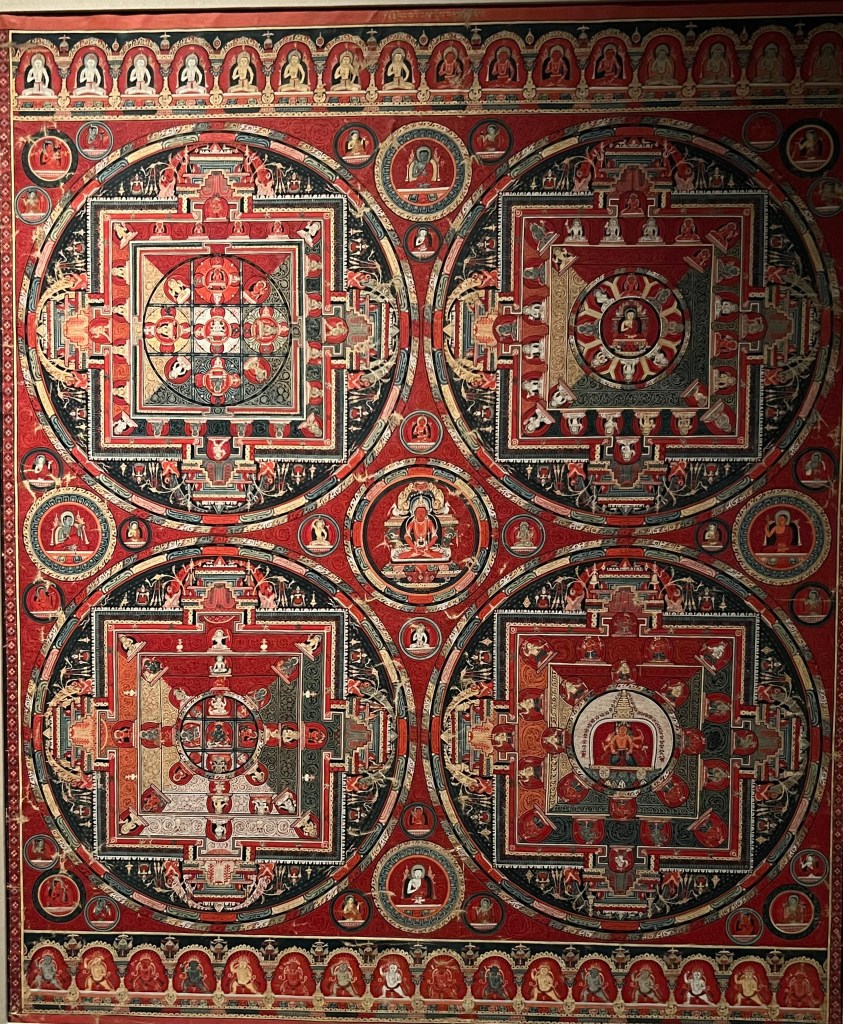 FOUR MANDALAS OF THE VAJRAVALI CYCLE
Wanggull and five other Newar artists (active mid-15th century)
Ngor Ewam Choden Monastery, Tsang region, central Tibet; ca. 1429-1456
This painting is the thirteenth in a set of fourteen paintings depicting mandalas of the Vajravali cycle, commissioned by Ngorchen Kunga Zangpo (1382-1456), founder of Ngor Ewam Monastery (1429), in memory of his deceased teacher Sazang Phakpa Shonnu Lodro (1358-14247). Remarkably, details of this set’s creation were recorded in monastic histories, which recount that it was made at Ngor Monastery by six itinerant Newar artists who came from the Kathmandu Valley, Nepal, to paint them, including the famous artist Wangguli. It is very rare to have surviving artworks that one can match to such detailed historical accounts of their creation. Ngor Monastery became particularly famous for meticulous, intricately painted mandalas-recognizable by a rich red and blue palette highlighted in yellow-that closely followed Newar aesthetics inherited from such itinerant Nepalese master painters.
Remarkable for its near pristine condition, this painting represents the culmination of Newar artisanship in Tibet, its refinement indicated by the size and precision of the figures, the variation in the delicate vegetal scrolls filling the background, and many of the minor motifs. Although the painting was made by Newari artists, the composition strictly follows Tibetan conventions and accounts of the work’s Tibetan commission
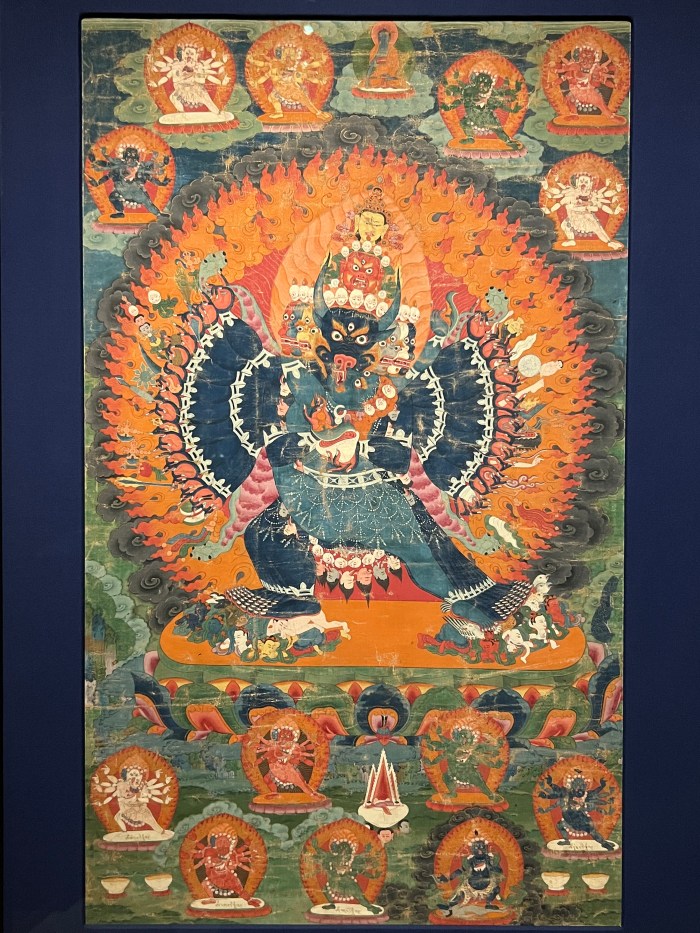
Tibet. 18th century
The wrathful Vajrabhairava presides over the highest class of tantric practice in Tibetan Buddhism: the Great Tantras, a form of meditation that alludes to a dualistic totality of compassion and wisdom. A guardian and destroyer of death, Vajrabhairava is represented here with thirty-four arms brandishing an array of weapons. His sixteen legs trample birds, dogs, and Hindu gods. He holds his consort Vajravetali, an animated corpse, in a sexual embrace (yab-yum). The couple is encircled by a flaming aureole and swirling clouds edged in gold.
Akshobhya, Vajrabhairava’s parent Buddha, presides above, along with manifestations of the many-armed deity Hayagriva.
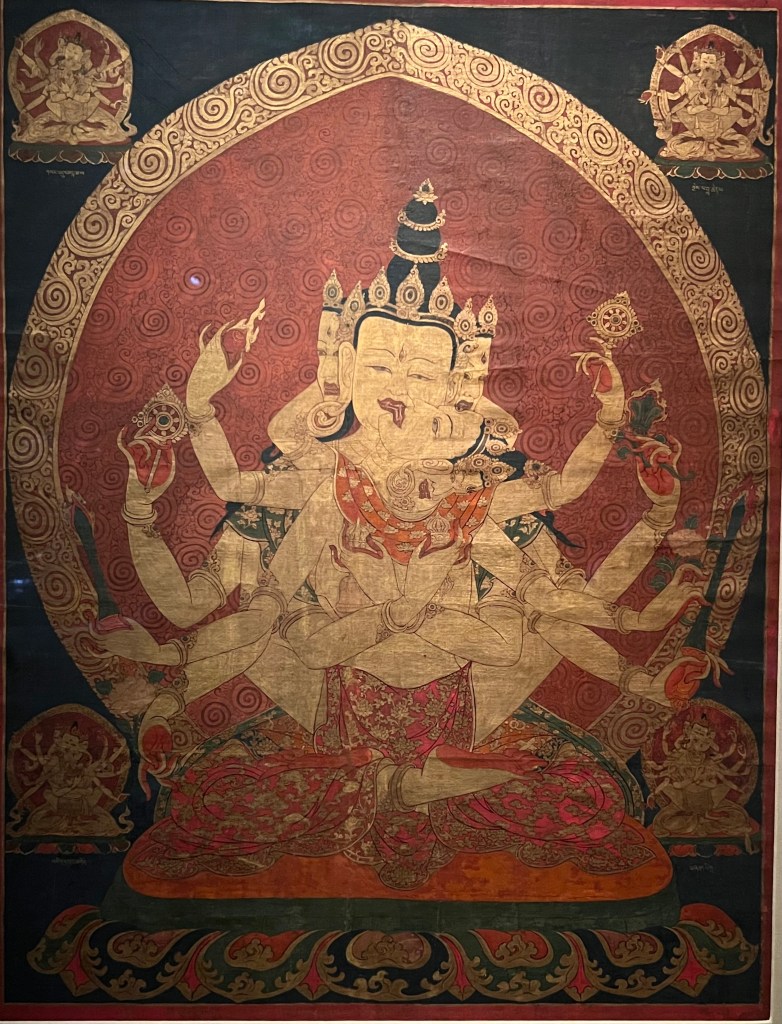
GUHYASAMAJA AKSHOBHYAVAJRA
Ngor Ewam Choden Monastery, Tsang region, central Tibet; ca. 1604
This painting of the meditation deity Akshobhyavajra was once part of a larger set of paintings created for the funeral services of the Fourteenth Ngor Khenchen, Jampa Kunga Tashi (1558-1603), suggesting a date of
1604. The gilding of the figures has no iconographic significance, but it may have been employed to increase the merit generated for the deceased.
Many of the stylistic elements-including the faces, scrollwork background, and hierarchical organization-are reminiscent of early Tibetan art. In contrast, the sense of movement, fullness, and patterns of the deities’ garments, such as the Chinese-inspired flowers and clouds, are more recent developments that emerged with the Khyenri painting tradition in the fifteenth century.
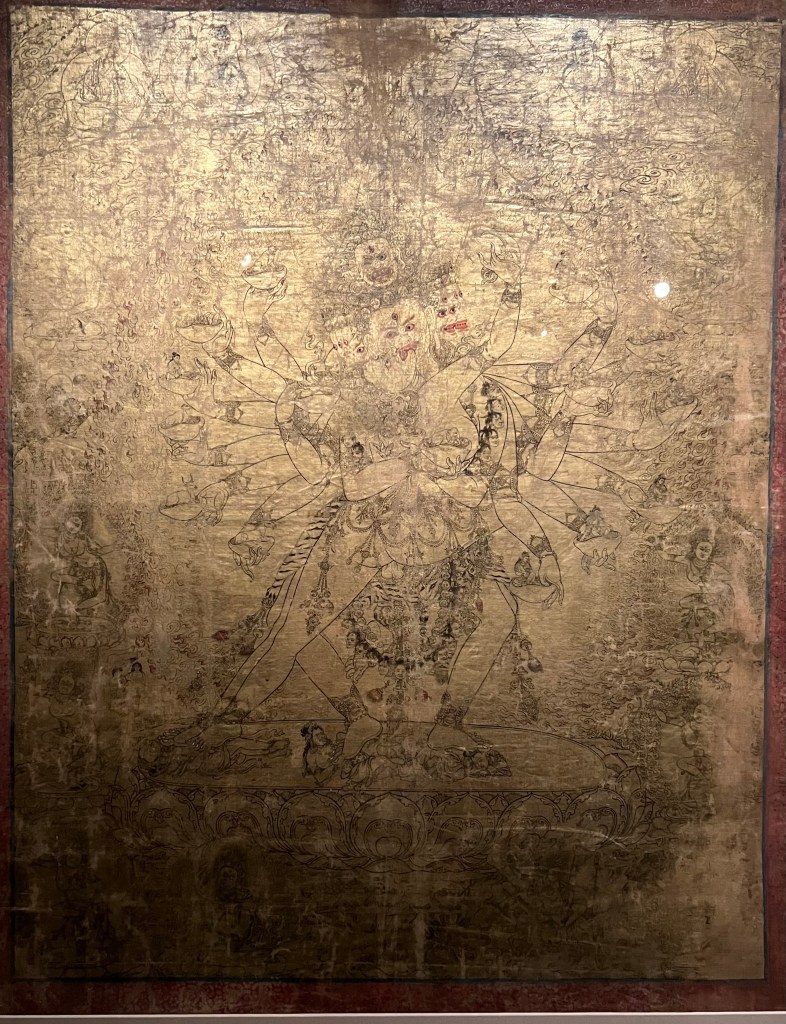
HEVAJRA WITH CONSORT NAIRATMYA
Central Tibet; mid-15th-16th century
This painting depicts Hevajra, the primary meditational deity (yidam) of the Sakya School of Tibetan Buddhism.
What makes this painting of special interest is an intriguing inscription on the back: “painted by Menthangpa.” It either names the artist as the famous founder of the Menri painting tradition, Menthangpa Menla Dondrup (active mid-fifteenth century), or a later follower. Yet the depiction of Hevajra seems to derive from another contemporary artist, Khyentse Chenmo.
Beginning in the mid-fifteenth century the indigenous Tibetan painting traditions of Menri and Khyenri-named after their respective Tibetan founders Menla Dondrup and Khyentse Chenmo (active ca. 1450s-1490s) —incorporated Chinese landscape elements into an otherwise Nepalese-inspired Tibetan painting tradition. The landscape depicted here is not designed to suggest spatial depth. Instead mountains and clouds are used as framing devices for the figures
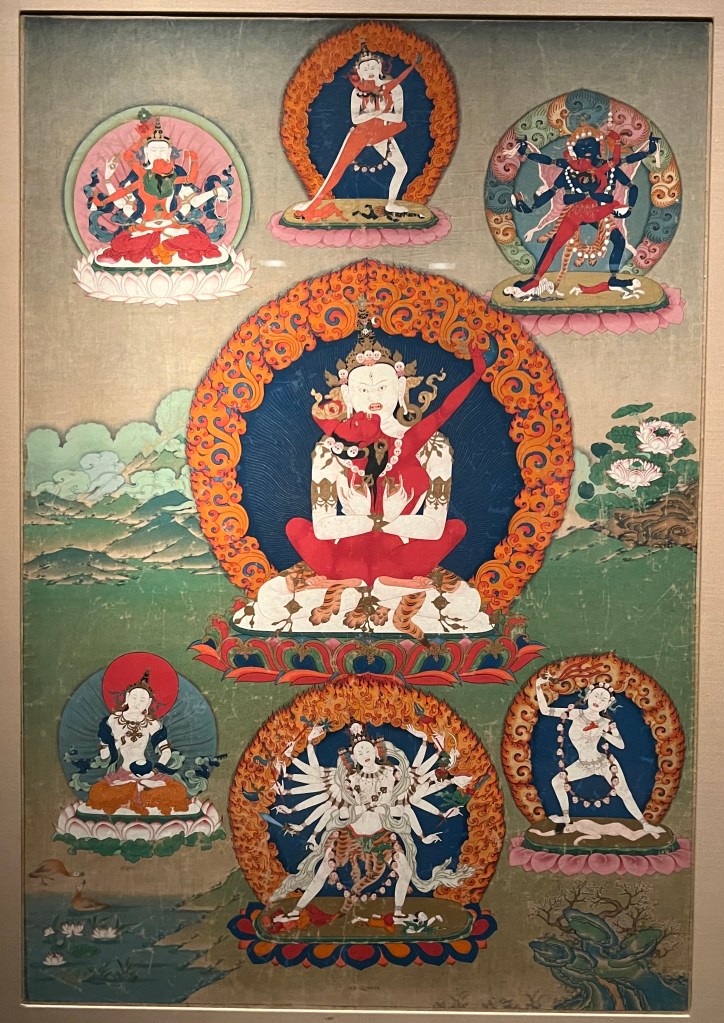
After Situ Panchen’s (1700-1774) Set of Twenty-Seven Tutelary Deities
Kham region, eastern Tibet; late 18th century
In 1750 Situ Panchen (1700-1774) commissioned twenty-seven paintings of major tantric deities from the master artist Jeto Tsewang Drakpa of western Kham. Situ personally designed each painting and took special care to ensure that their proportions agreed with the systems prescribed in the Kalachakra and Samvarodaya tantras, the classic Indian scriptures that served as the ultimate authorities on iconography.
This is the first painting of that series, with White Chakrasamvara depicted as the main figure.
This piece is an example of a painting method unique to the painters of the Encampment Style, in which the artist builds up the landscape by applying successive layers of blue and green pigment in dry dots using the tip of the brush. Instead of a unified composition, the figures here seem pasted into the landscape, a pastiche of visual references from earlier figural styles, such as Khyenri, and decorative designs in a Chinese-inspired blue-green landscape.
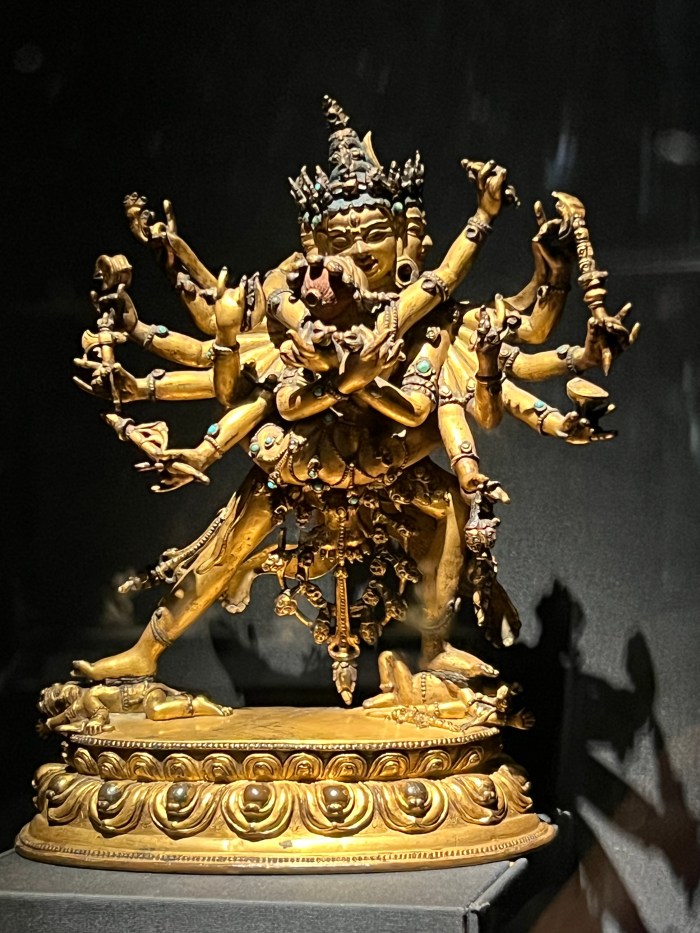
Tibet Late 15th-16th century
Chakrasamvara and his consort, Vajravarahi, was a favored subject for visualization in Tibetan Buddhism, as experienced by an advanced tantric master meditating upon the Chakrasamvara Tantra text. The couple, seen standing in sexual embrace, are key deities in the Vajrayana system, uniting two of the most powerful ideas in esoteric Buddhism: wisdom, embodied in Vajravarahi; and compassion, the essence of Chakrasamvara.
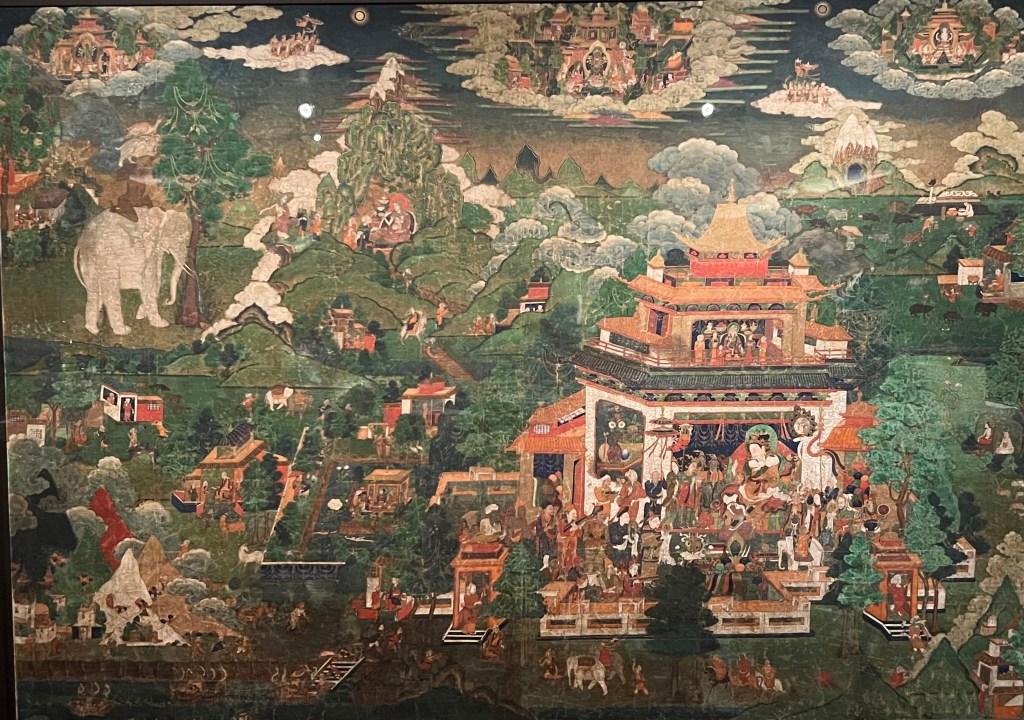
Central Tibet; 17th century
In this painting Tibet’s sacred geography is mapped out, with Mount Wutai and its distinctive five multicolored peaks to the east (bottom left) and Mount Kailash’s snowy peaks towering over nomadic scenes of the Northern Plains to the west (top right).
The central imagery in this painting accords with a prophecy in which a universal ruler transforms the world into an ideal realm. Here the king sits in a palace surrounded by representatives of various races and nations who have come to make offerings at his feet.
This work of art represents later developments in the painting traditions in central Tibet, dominated by rich green and blue landscape palettes, dense lively compositions, highly decorative ornamentation, and dramatic landscapes.
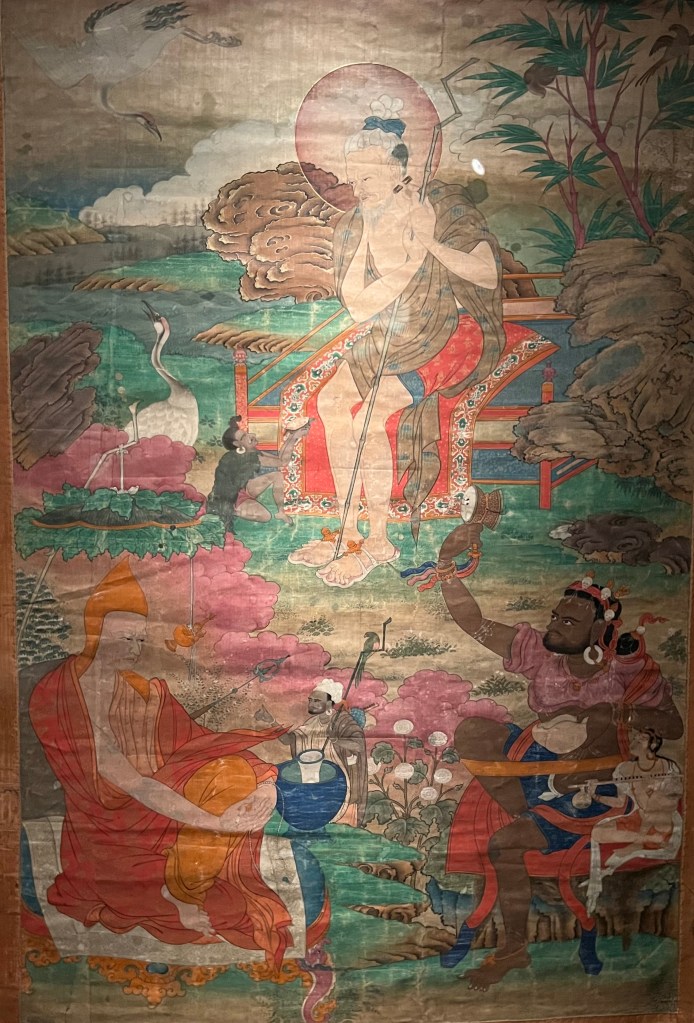
Central Tibet; ca 17th century
This painting is from a large set depicting the eighty-four great Tantric adepts (mahasiddha) of India. It portrays three of them, including both monastic and lay yogis. The painter had to follow a strict set of rules regarding iconography, but he nonetheless infused each of the adepts with their own personalities. This finely crafted painting is a delicate balance of colors.
It abounds with details to draw the eye, such as the colorful parrot sitting in the crook of a staff below.
Several scholars have attributed this painting to the Khyenri Style, which is known for its figures with delicate, differentiated facial features, realism, and fine attention to detail, especially in animals. However, the Sakya School lamas of central Tibet already had a long tradition of such portraiture in Chinese-inspired landscapes that went back to the early fifteenth century, when the Ming Yongle emperor (1402-1424) of China offered similar paintings to Tibetan hierarchs.
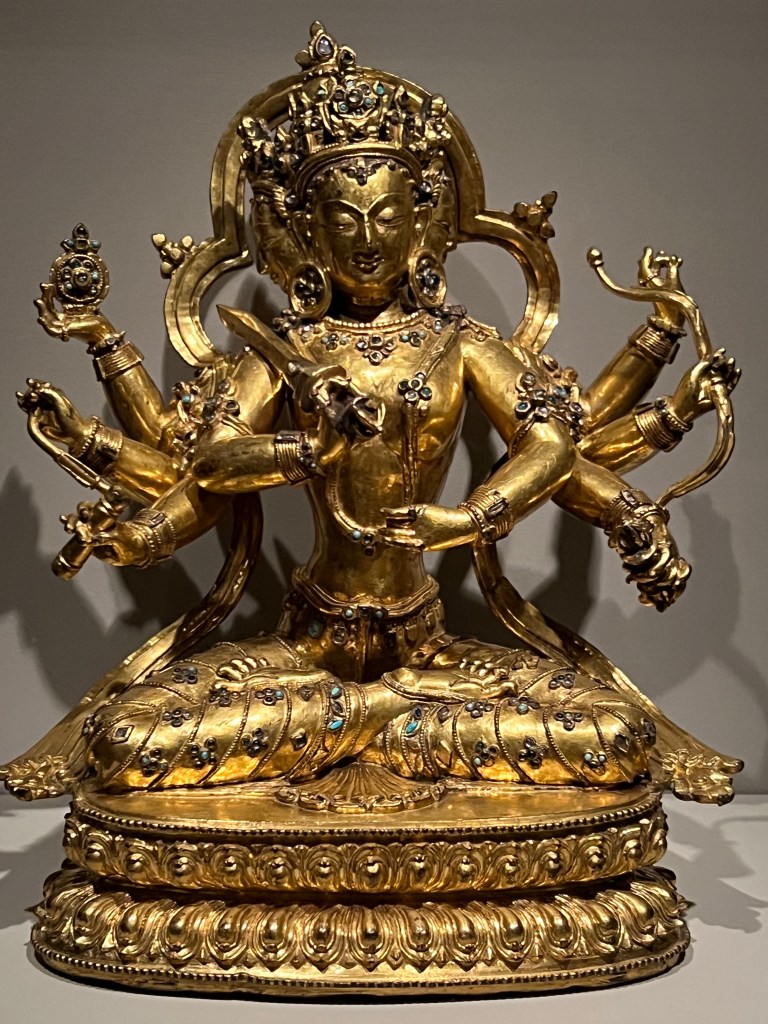
Central Tibet; mid-14th-mid-15th century
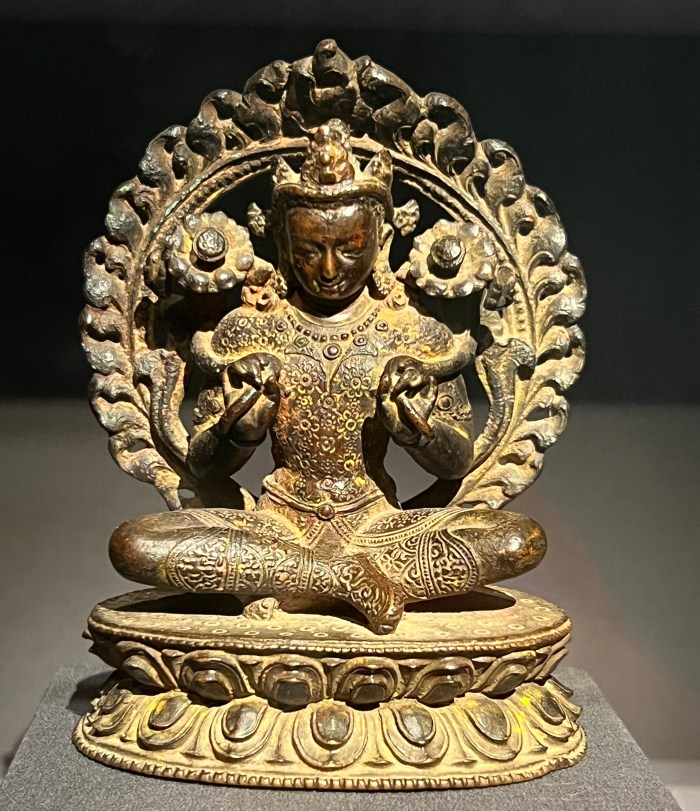
Pratisara is one of the Five Protector Goddesses (Pancha Raksha), personifications of five early Esoteric Buddhist spells (mantras) with protective powers. Of the five she is often considered the principal figure and protects from sin and illness.
This slender image bears typical characteristics of late fourteenth- and early fifteenth-century sculpture.
The slim figure is slightly bent towards the left, and her multiple heads and arms are stacked in a way that makes them appear almost natural. The double-lotus base with its slim petals is typical for Nepalese craftsmanship of this period, both in Tibet and at the Chinese court.
In its elegance of form and ornamentation this bronze demonstrates the continuing importance of Nepalese craftsmanship in Tibet, as famously represented by the sculptures of Densatil in Tsang region, central Tibet, to which this sculpture has been attributed
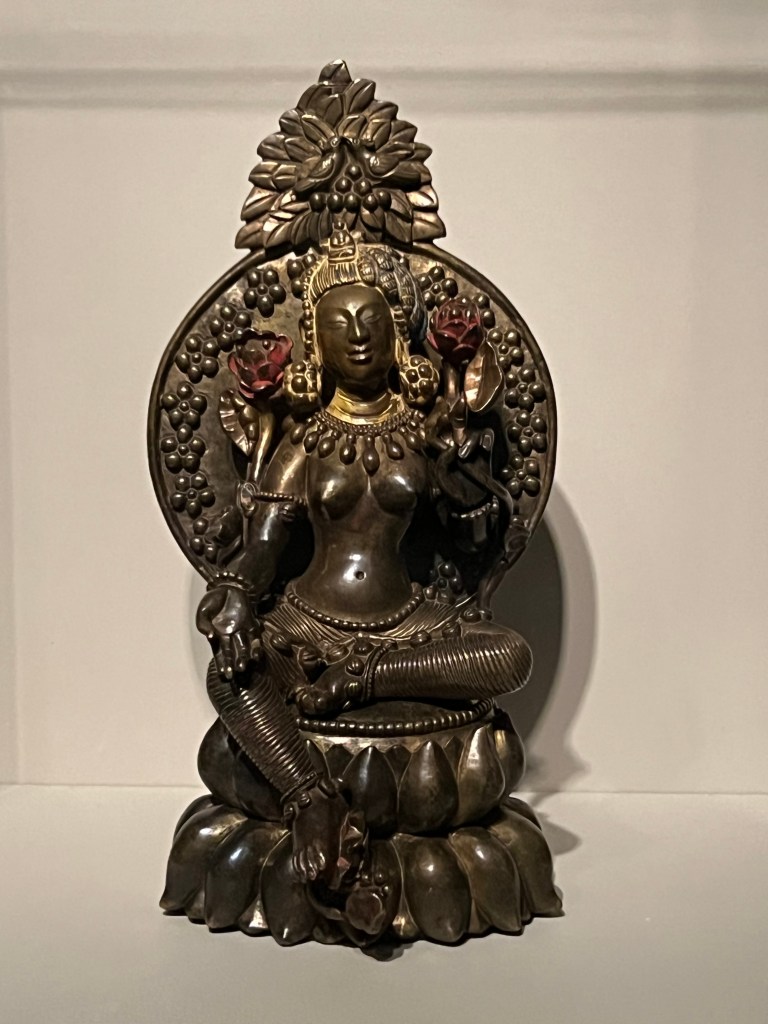
Tibet; 17th century
Few Tibetan artworks can be attributed to a specific artist, and by far the most remarkable among them are those associated with the Tenth Karmapa, Choying Dorje (1604-1674). A renowned Tibetan artist and religious leader, Choying Dorje looked to a range of traditions, including Chinese art of antiquity for inspiration in his paintings and ancient metalwork from the regions of Kashmir and Swat for his sculptures. The fleshy lotus petals that make up Tara’s seat and the striated pattern on her tight-fitting clothing reveal this connection.
Aspects of the Tenth Karmapa’s personal figural style include the thick plates of hair piled on the left side of Tara’s head and the thick plasticity of her ornaments, such as her tremendous earrings and the bulbous bobbles of her necklace. The Karmapa often subtlety incorporated his love of animals into his works, as seen in the pair of birds nestled in a leafy bower above the goddess’s head.
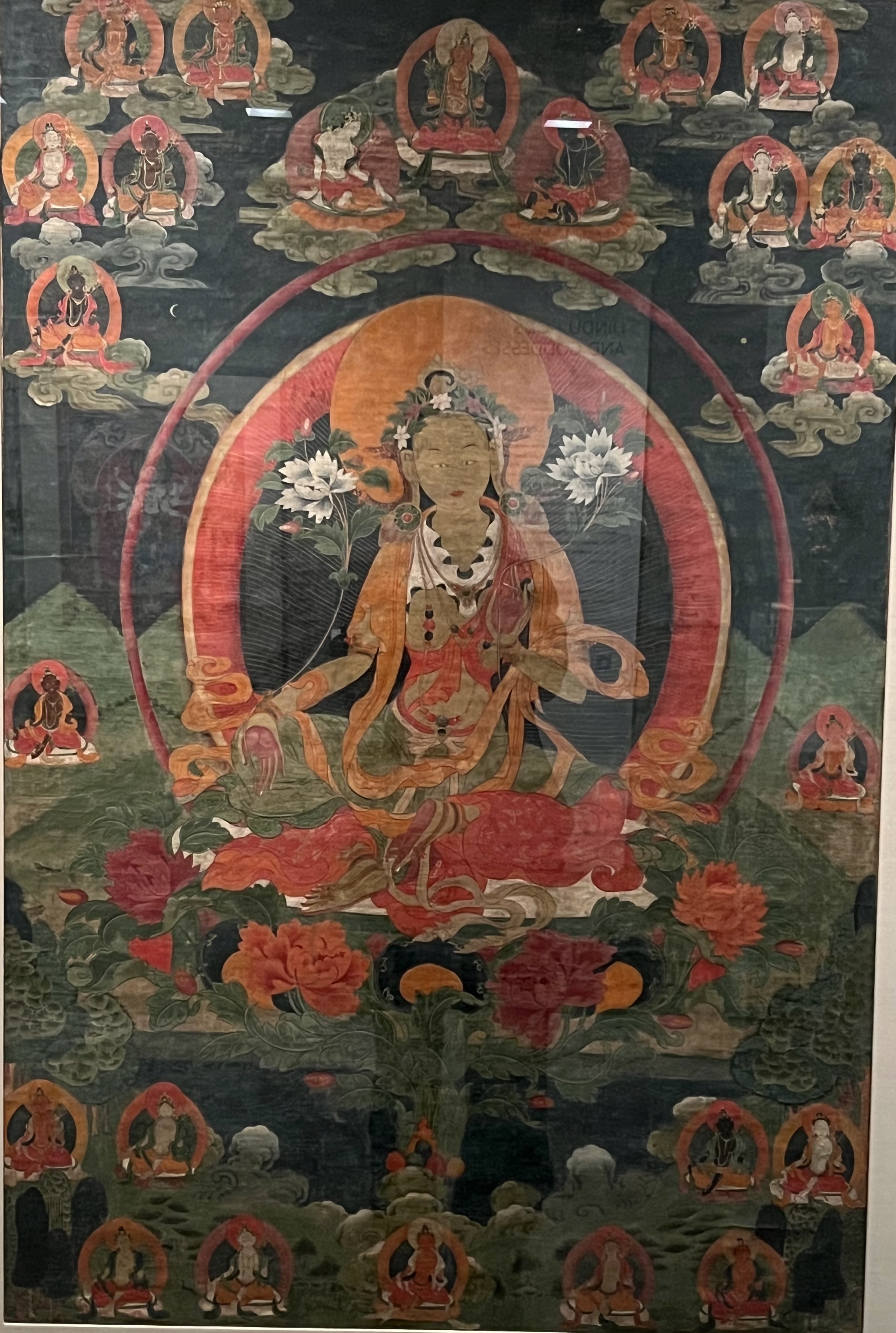
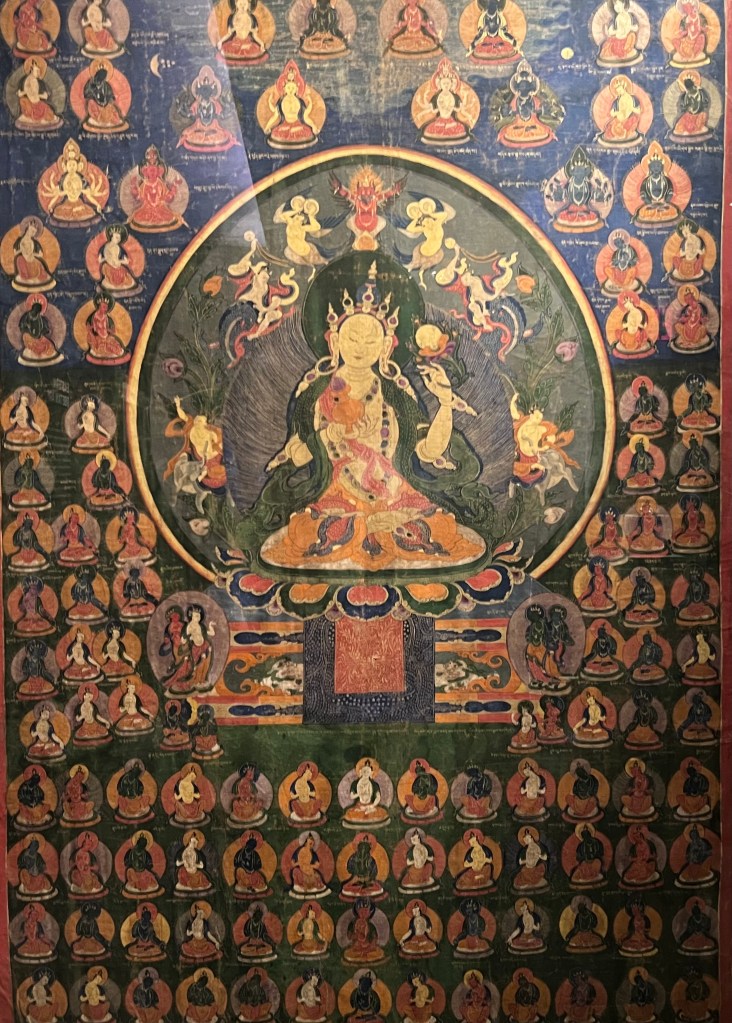
Eastern Tibet; 19th century
Sherab Chamma, the Loving Mother of Wisdom, is the principal female deity of Bon, a religion indigenous to Tibet. Her primary role is that of a compassionate mother figure, embodying wisdom. She is therefore considered the mother of all Bon deities and enlightened ones.
Bon coexisted with Buddhism for centuries in some communities, and local painters created works for both religious traditions, drawing on the same visual vocabulary. The deep, flat blue and gray hues suggest this painting might be from southern Amdo or northern Kham region, where the Bon religion flourished in the eighteenth and nineteenth centuries
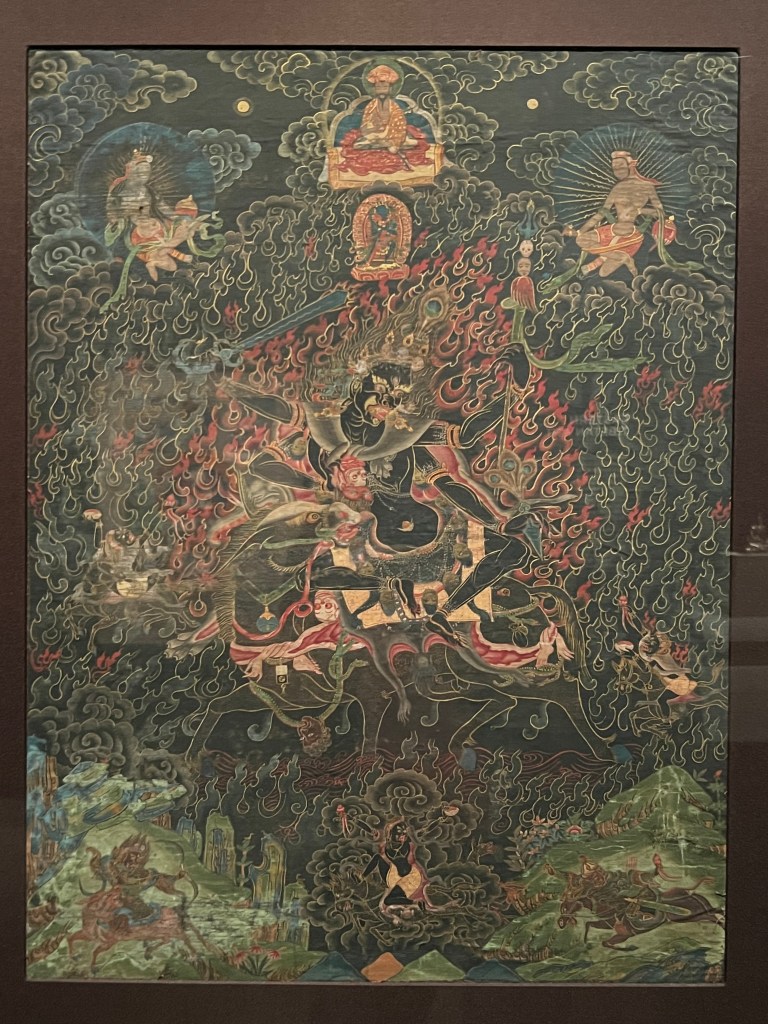
Bhutan 19th cestury
Palden Lhamo (Sanskrit: Shri Devi) counts among the primary protector deities of Tibetan Buddhism. Here she is shown in her “smoke-clad” form (Dusolma) riding a white-nosed donkey and surrounded by flames and billowing clouds of smoke. Her emaciated form is suggested by her sunken chest and gaunt limbs. To her left and right and below her are members of her retinue, which includes three mounted ferocious female attendants. Each of these frightening figures holds a skull cup and heart in her hands. At the top center is the Bhutanese Drukpa School hierarch Shabdrung Ngagwang Namgyal (1594-1651), who was also founder of the Bhutanese theocratic state. This Bhutanese painting combines a black background with a small portion of blue-green landscape at the bottom of the canvas, creating the sense that one is looking beyond coastal rocks onto an ocean of blood under a black sky. The edges of clouds, smoke, flames, and rocks are highlighted in gold and form an irradiant setting for the black goddess. The rocks in the foreground feature flowers and birds unimpressed by the wild hunt taking place around them.
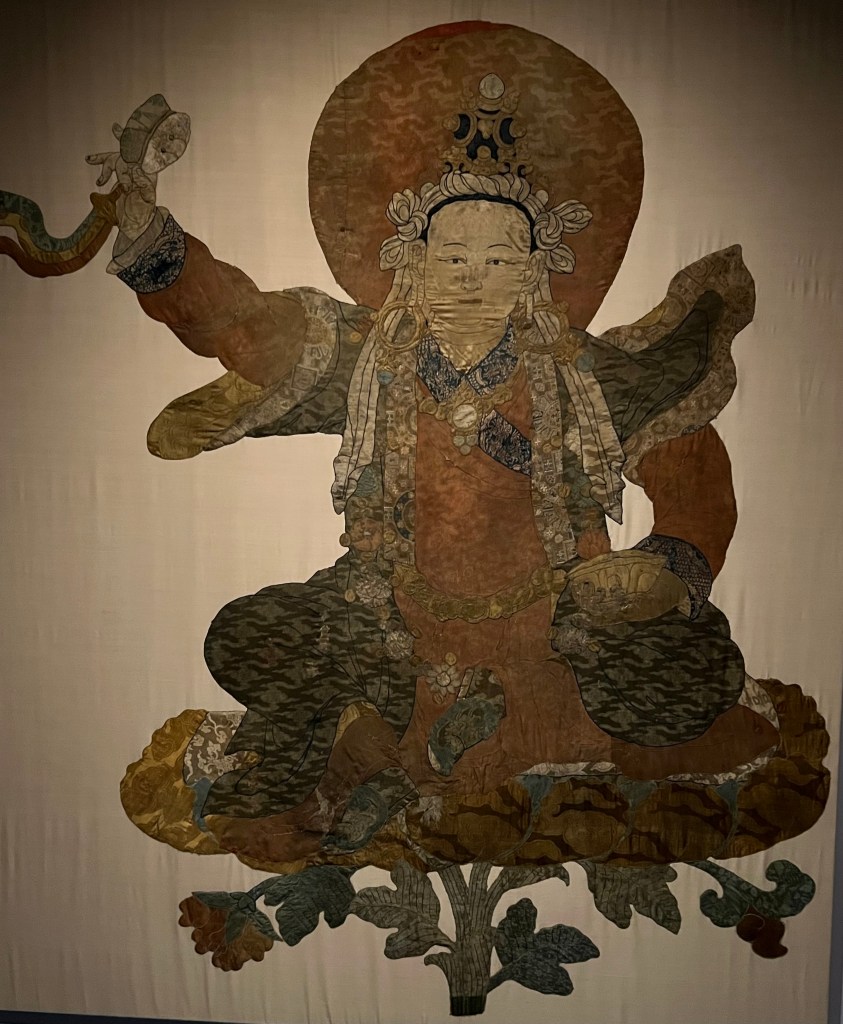
Tibet or Bhutan; ca. 19th century
This figure richly attired in royal garb, playing a hand drum and holding a skull cup, represents a manifestation of the legendary wizard and founding saint of Tibetan Buddhism, Padmasambhava, called Loden Chokse. Padmasambhava’s life was said to be full of magical battles and teaching activities in India and across the Himalayas, which earned him many names by which he became known.
These names assumed specific iconographic forms that are thought to represent his various aspects.
Loden Chokse represents the (lay-tantric) scholar manifestation of Padmasambhava.
Although of substantial size itself, this is only a detail of what was once a huge, impressive appliqué depicting the Buddhist master surrounded by all eight of his manifestations. Such large appliqué images are made of scraps of multicolored silks in various patterns that are cut to shape, cleverly integrated into a complex rendering, and sewn into gigantic compositions. These huge textiles are displayed at annual celebrations for communal viewing on the outside wall of a monastery or the side of a hill. They are found all over the Tibetan Buddhist world and are especially popular in Tibetan, Bhutanese, and Mongolian regions.
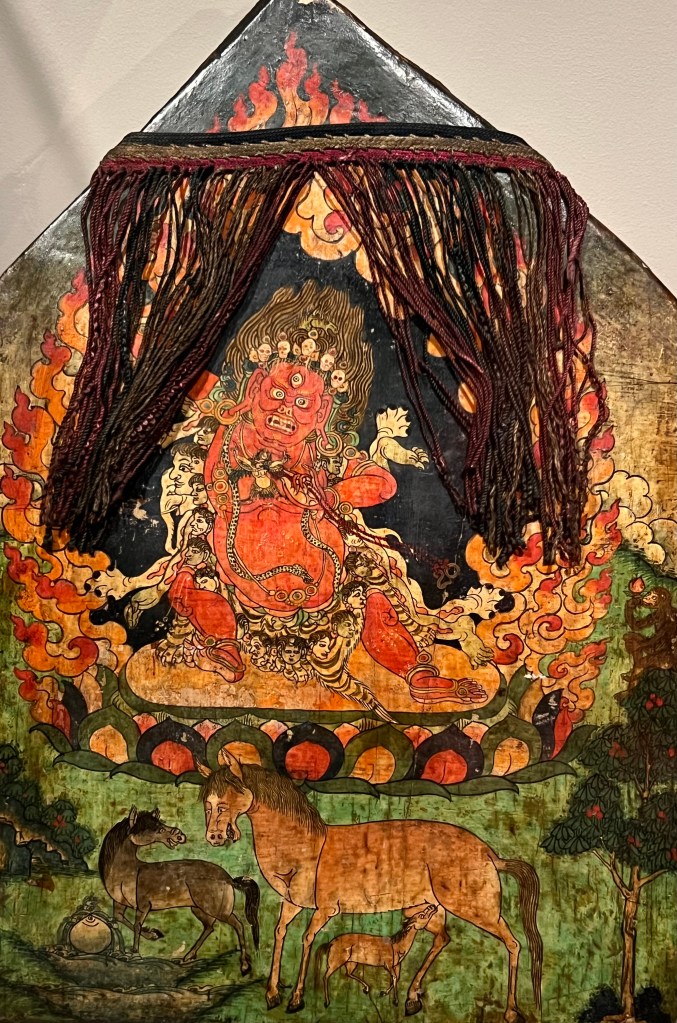
Tibet or Mongolia; 18th century
This painted wooden panel depicts Hayagriva, the Horse-Necked One, a tantric meditational deity (yidam) and a powerful remover of obstacles. He is recognizable by the horse head peaking from his flowing hair at the crown of his head. Across Asia, Hayagriva is popularly worshiped as the patron god of horses, here invoked in the sensitive depiction of horses at the bottom, complete with a charming bucolic scene of a mare nursing her foal.
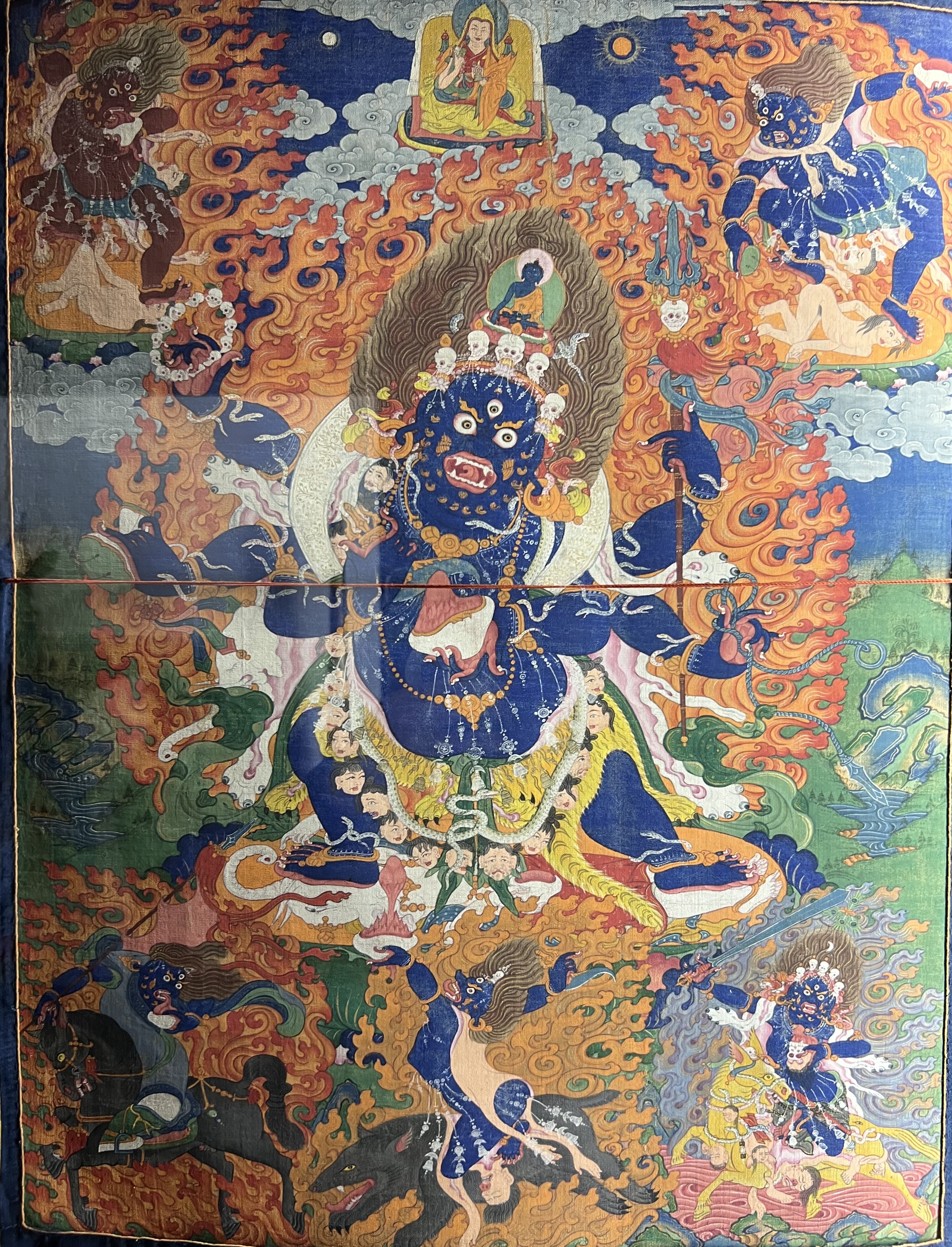
Тибет. ХІХ век
Махакала — «Великий Чёрный», один из самых сильных защитников учения, возглавляет группу Восьми ужасных. Наиболее почитаемая среди российских буддистов форма — Шестирукий Махакала Гонпо с тремя глазами и иссиня-черным телом. Его основные атрибуты – нож-резак и чаша из человеческого черепа, а также четки, барабанчик, трезубец и аркан. Шкура слона на плечах и попираемый Ганеша символизируют преодоление препятствий и заблуждений.
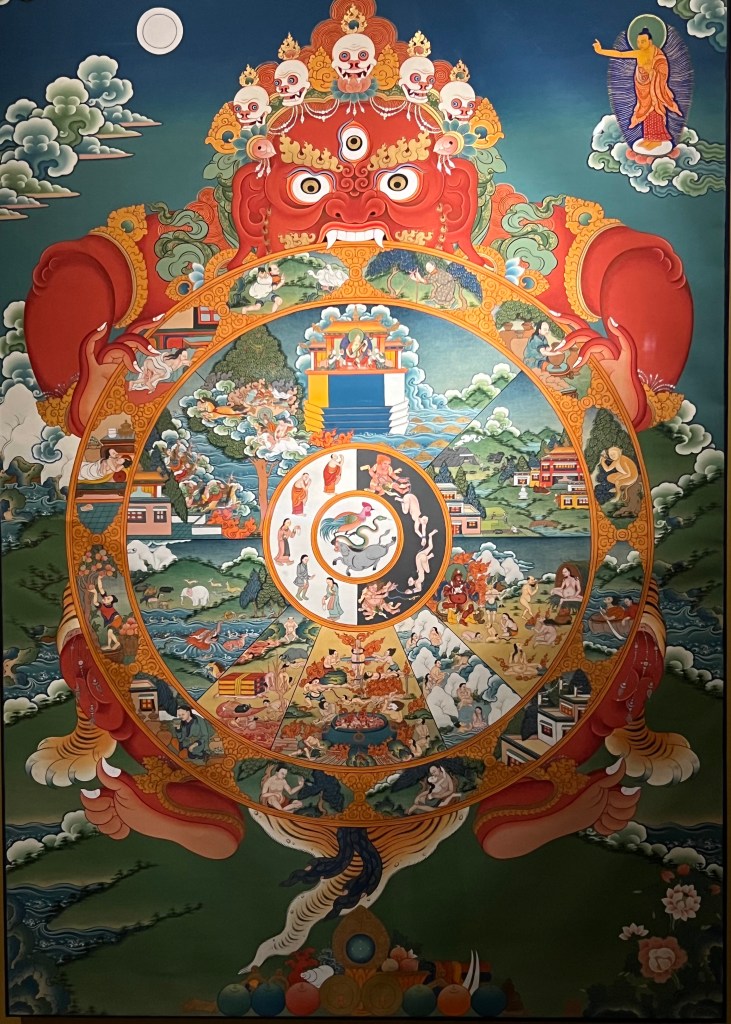
This instructional composition is said to have been designed by the Buddha. It illustrates his fundamental insights into the nature of existence, including rebirth and the cycle of unenlightened existence called samsara.
The painting’s details remind Buddhists of the benefits of positive actions and the dangers of accumulating bad karma through negative actions. Typically painted near the entrance of temples, the composition ignites a sense of urgency to engage in positive behavior, including prayer, contemplation, and making offerings in shrines.
The painting’s symbolism presents layered meanings and urges believers to direct all of their senses-sight, smell, taste, hearing, touch, and consciousness, Buddhism’s sixth sense-beyond the mundane and toward the sacred.
BUDDHAS
The term buddha, meaning “awakened” or “enlightened,” was first used to refer to Shakyamuni, who lived some time between the sixth and fourth centuries ce in northern India and whose teachings became the foundation of Buddhism. Shakyamuni became the Buddha by achieving enlightenment (a complete understanding of the true nature of reality, freeing him from the endless cycle of suffering that is birth, death, and rebirth. Over time “buddha” came to refer to not only one person but all manifestations of enlightenment. Buddhas are said to possess distinct marks that are shown in their representations, most notably a cranial protuberance (ushnisha), a tuft of hair between the eyebrows (urna), and long earlobes, and they are usually shown wearing the robes of a monk.
BODHISATTVAS
Bodhisattvas are traditionally described as beings who aspire to attain enlightenment and help others to achieve it. They can be male or female and are portrayed adorned with crowns, jeweled ornaments, and garments of Indian royalty. The greatest of the bodhisattvas are near enlightenment and are regarded as deities with abilities nearly equal to those of buddhas. They can be identified by distinctive attributes that symbolize their particular enlightened qualities-such as the book and sword.
TANTRIC DEITIES
Tantric deities are the focus of esoteric religious practices (tantras that aim to radically transform conventional understandings of reality. Numerous forms of these deities, described in religious texts also called tantras, personify various enlightened qualities and can appear peaceful or wrathful. Tantric deities and practices are as diverse as people’s needs and capacities. Female and male deities in sexual embrace represent the unity of wisdom (understanding of reality) and method (compassionate action), two aspects of the enlightened mind. Tantric deities can have multiple heads, arms, and legs, symbolizing their many abilities.
FEMALE DEITIES
Bodhisattvas and tantric deities can be depicted in female form. In the Tibetan tradition these deities are recognized by their feminine figure, smaller size, and more oval-shaped face. Just like their male counterparts, they embody specific enlightened qualities and can be both peaceful and wrathful in appearance. As female bodhisattvas they are frequently depicted accompanying buddhas or male bodhisattvas. As female tantric deities they symbolize the wisdom aspect of the enlightened mind and are often shown as consorts of male deities.
Nepal, Kathmandu Valley, early Malla period,
14th century.
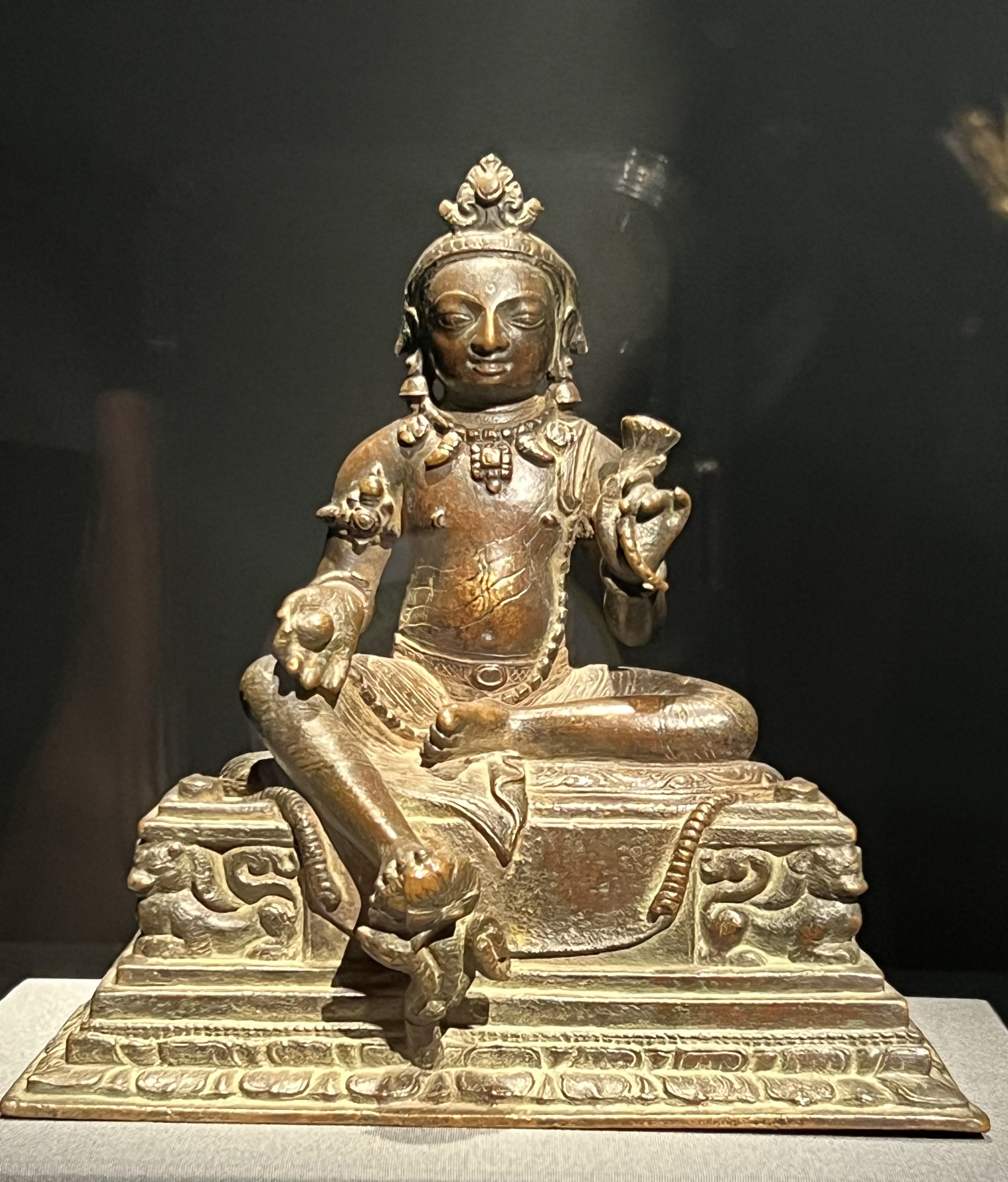
Surya is considered the source of light. His origins can be traced to the earliest Indian text, the Rigveda, and his conventional West Asian mode of dress affirms his links to the solar cults of early Iran. He wears a tunic and high boots typical of early Iranian imagery and holds two lotuses in full bloom-emblems of the sun’s power.
Licchavi-Thakuri periods, 10th century
Manjushri, a bodhisattva who embodies wisdom as the path to enlightenment, is closely related to the wisdom goddess Prajnaparamita. Both emerged in north Indian religious texts and imagery in the eighth century. Manjusrhi was a popular Buddhist savior figure in Licchavi Nepal.
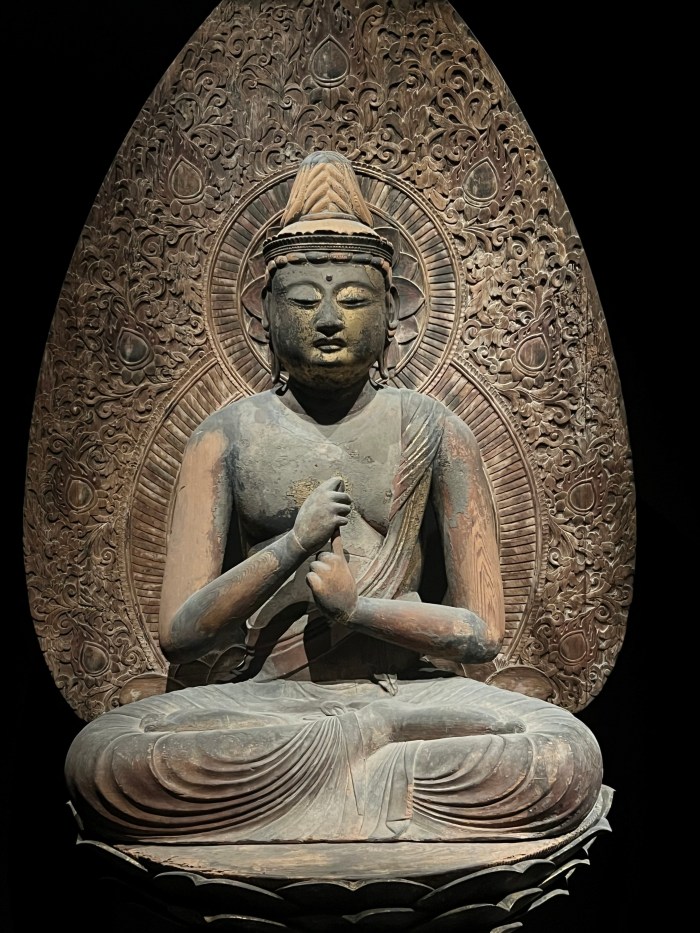
Heian period (794-1185), 12th century
Wood with lacquer and gold leaf
In Esoteric Buddhism, the entire universe is believed to emanate from Dainichi Nyorai, the supreme Buddha of the cosmos. Dainichi’s mudra, with the left index finger surrounded by the fingers of the right hand, is known as the “wisdom fist.” This powerful gesture expresses the union of the spiritual and material realms and is thought to restrain passions hindering the practitioner’s enlightenment. In paintings and sculptures, Dainichi often assumes this pose while surrounded by the other four Wisdom Buddhas, representing the metaphysical world of complete enlightenment-known as the Diamond Realm in Esoteric doctrines.
Art of Nepal
Nepalese art is dominated by the rich interwoven traditions of Buddhist and Hindu religious imagery, ritual utensils, and sacred architecture produced in the Kathmandu Valley over the past 1,200 years. Sacred sites beyond the valley-such as Lumbini, the Buddha Sakyamuni’s birthplace, in western Nepal-were also of seminal importance and served as key pilgrimage destinations. The Licchavi kingdom (4th-9th century) was likely established by a branch of the north Indian Gupta clan. Licchavi art displays a strong Gupta influence, as does the transitional art of the succeeding Thakuri dynasty (10th-12th century). The year 1200 marked the beginning of the Malla dynasty, which brought stability and prosperity to the kingdom. In 1482 the Malla kingdom was peacefully divided into three city-states-Kathmandu, Patan, and Bhaktapur-each ruled by a branch of the Malla family. They prospered, largely through trade, and generously patronized religious sites throughout the valley, especially in the three urban centers. Their rule ended in 1768-69, when they were displaced by the Shah clan, a Rajput family, which ruled until 2008.
The religious art of Nepal reflects exchanges with a succession of northern Indian cultures: Kushan (2nd-4th century), Gupta (4th-6th century), and Pala-Sena (8th-12th century). A powerful stimulus came in the late twelfth century with the collapse of monastic Buddhism in north India, resulting in an influx of monks and religious objects. The Newari artists of the Kathmandu Valley absorbed these influences and transformed them into a uniquely Nepalese style, which in turn had a pervasive influence on Tibetan art.
Art of Tibet
Tibetan art, like traditional Tibetan society in general, was shaped by the central role of monastic Buddhism. Over time, four major orders of Buddhism emerged across the Tibetan plateau, each with a different lineage. All practiced Vajrayana Buddhism, based directly on tantra, a form of esoteric religious practice adopted from medieval India. Central to the creation of tantric art is the process of visualization, achieved through meditation by an advanced practitioner. The sculpture, murals, and cloth paintings (tangkas) thus created served as aids to future generations of practitioners, both novices and adepts. Indian mahasiddhas (“great adepts”)-tantric yogini masters of religious magic and sometime authors of tantric treatises-were revered in Tibet, eighty-four being canonized.
Buddhism arrived in Tibet from India during the fifth century and was further stimulated by interactions with Chinese Tang Buddhist culture. A seminal moment was the arrival of Padmasambhava (“lotus born”), a revered Indian exponent of tantric Buddhism. In the late eighth century, King Trisong Detsen invited him to Tibet, where he founded the Nyingma Order, the oldest school of Tibetan Buddhism. With him came the first wave of external influence, from Kashmir. In the eleventh century, the famed Bengali monk Atisha was invited to Tibet to reintroduce Vajrayana orthodoxy, often characterized as the “second wave.” Successive waves of artistic stimulus came from Central Asia, China, Kashmir, Pala India, and Nepal. Perhaps most significant was the work of itinerant artists from Kashmir and, especially in later centuries, from the Newaris of Nepal. Both were famed and respected for their artistic contributions to monastic art in Tibet, and their legacy resulted in the synthesis we recognize as the Tibetan style.
In the 7th century A.D. numerous tribes having dwelt in the highland of Tibet were united under the rule of Yarlung dinasty. The consolidation of their state, Bod-yul, was followed by the adoption of Buddhism in the 8th century. At the beginning of the 15th century a new branch of Buddhism came to being. The monk Tsong kha-pa became a founder of the new teaching Gelug, (better known as Lamaism, from the Tibetan blama, monk, teacher”). Lamaistic cult and mythology have found their bright expression in tibetan art as well as produced similar cultural forms in the neighbouring Mongolia or South Siberia. Among them fine plastic images of Buddha and bodhisattvas, scroll paintings thanka, masks and costumes for the personages of mystery-play tsam would be called as typical for the wide area, including Tibet, Mongolia, Buryatia, Tuva, etc.
Tibetan metal sculptures (mainly bronzes) were executed according to the iconographical principles in the way of the so called “lost wax”. The method consisted of modelling a wax fig- • ure, covering it with several lays of wet clay which formed a mould, and pouring melted metal into the dried mould through the holes so that wax was replaced by metal. Canonical poses, jes-tures and proportions could be precisely observed when using this technic.
While sculptural images served as objects of devotion, painted scrolls were also used as illustrations to narration of different kinds, such as buddhistic legends, stories about famous saints and teachers etc. A main character of the story was usually represented in the center, surrounded by the pictures of various episodes of his life and deeds. Pigments used for thanka painting were made of natural matters, often of precious and semi-precious stones, the detailes would be outlined with gold. Both sculpture and painting, executed by the monk artists according to the prescribed rules, included depicted symbolical objects, such as a chacra (a wheel of life, or of time, or of Law), a vajra (a lightning or diamond rod, a symbol of celestial truth and divine knowledge). Combination of the vajra with a bell or a lotus represented the unity of male and female beginnings of the Universe. The same objects were used in Lamaist rites and, so, produced of diverse matters by the traditionally educated artisans.
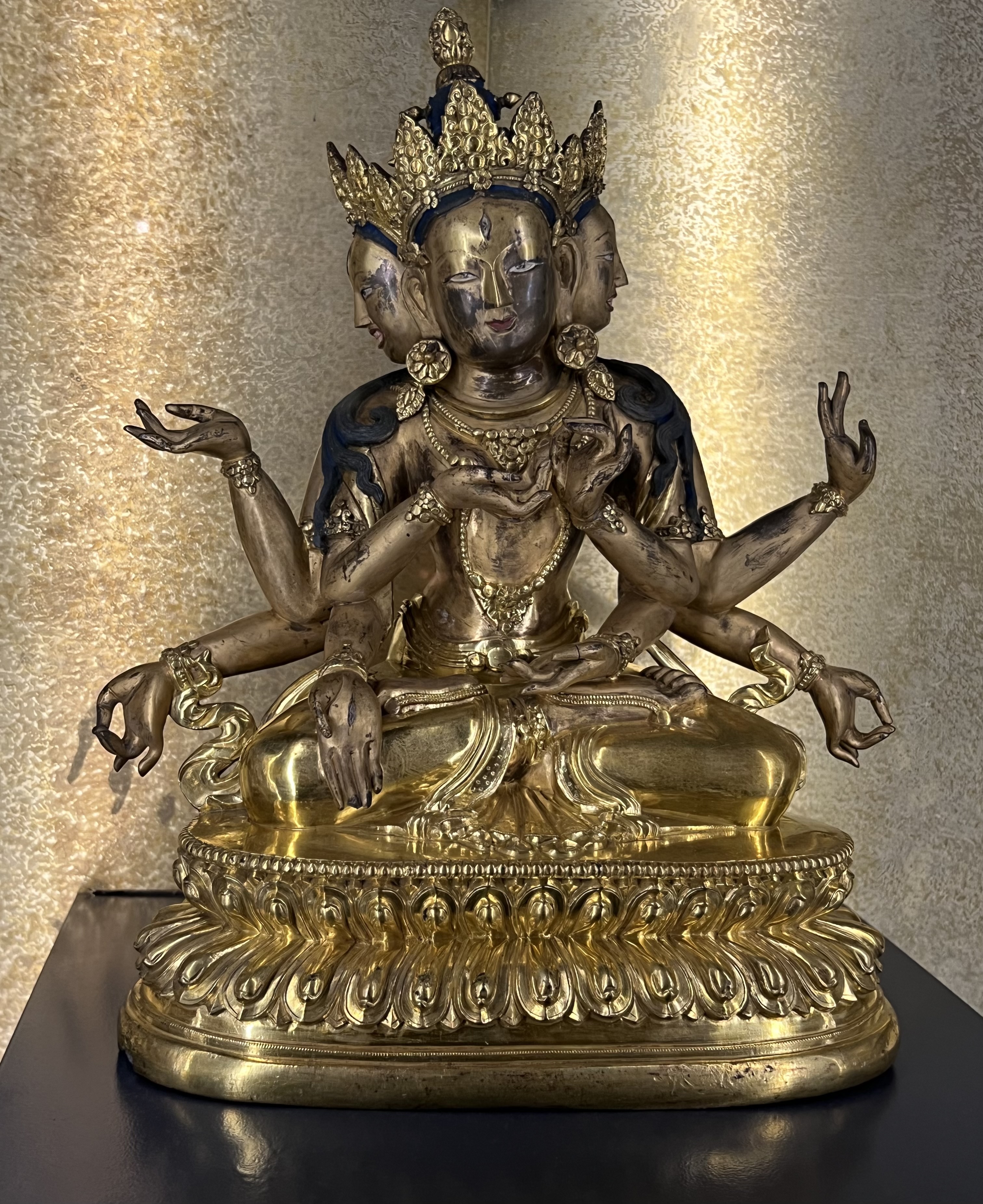
Китай. XVIII — начало XIX века
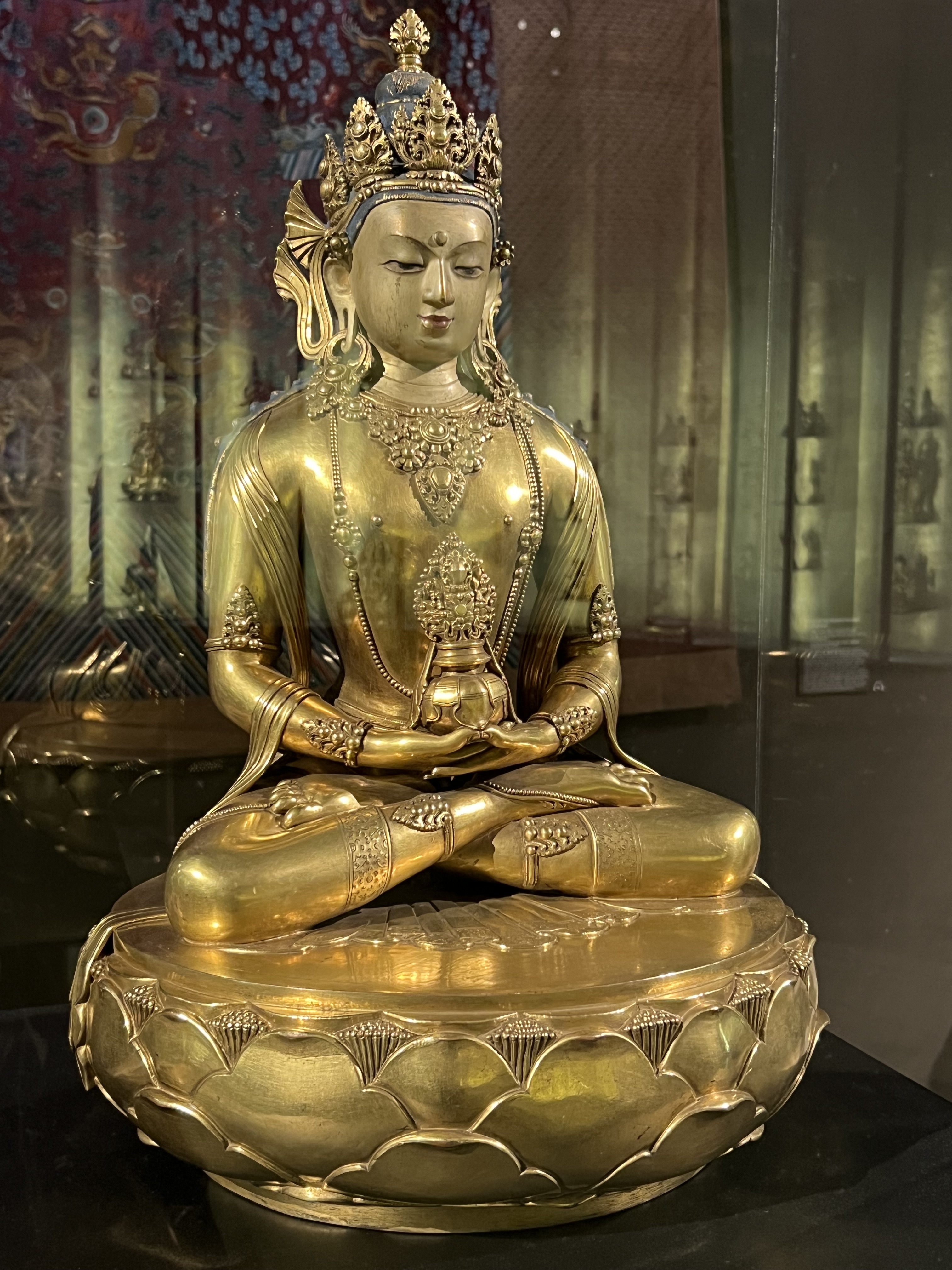
Монголия. XVI век
Важнейшую роль в развитии буддийского искусства Монголии сыграл Даанабадаар- выдающийся религиозный деятель, скульптор и основоположник собственной художественной школы. Созданные им образы стали образцом для многих поколений мастеров. Характерные черты этого стиля можно увидеть в шедевре Национального музея Республики Бурятия – скульптуре Амитаюса, будды беспредельной жиани. Для произведений школы Дзанабадзара характерны гармоничные пропорции, безупречное литье и особое внимание к деталям. Тщательно проработанные черты лица, плавные линии фигуры, изящные жесты рук и тонкая моделировка форм придают образу необыкновенную живую красоту и притягательность, сохраняя при этом идеал просветленного существа.
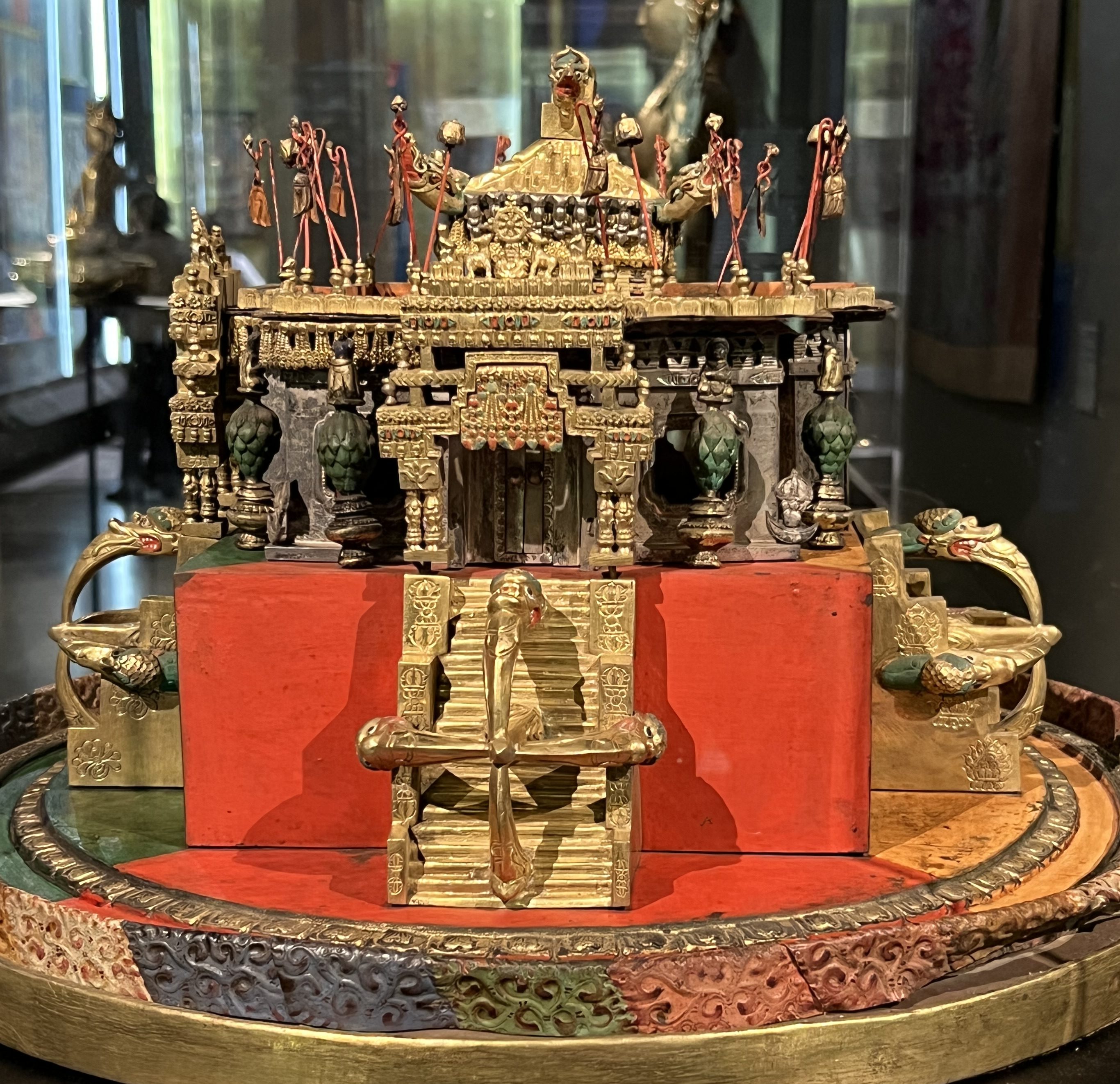
Внутренняя Монголия, Долоннор. XIX век
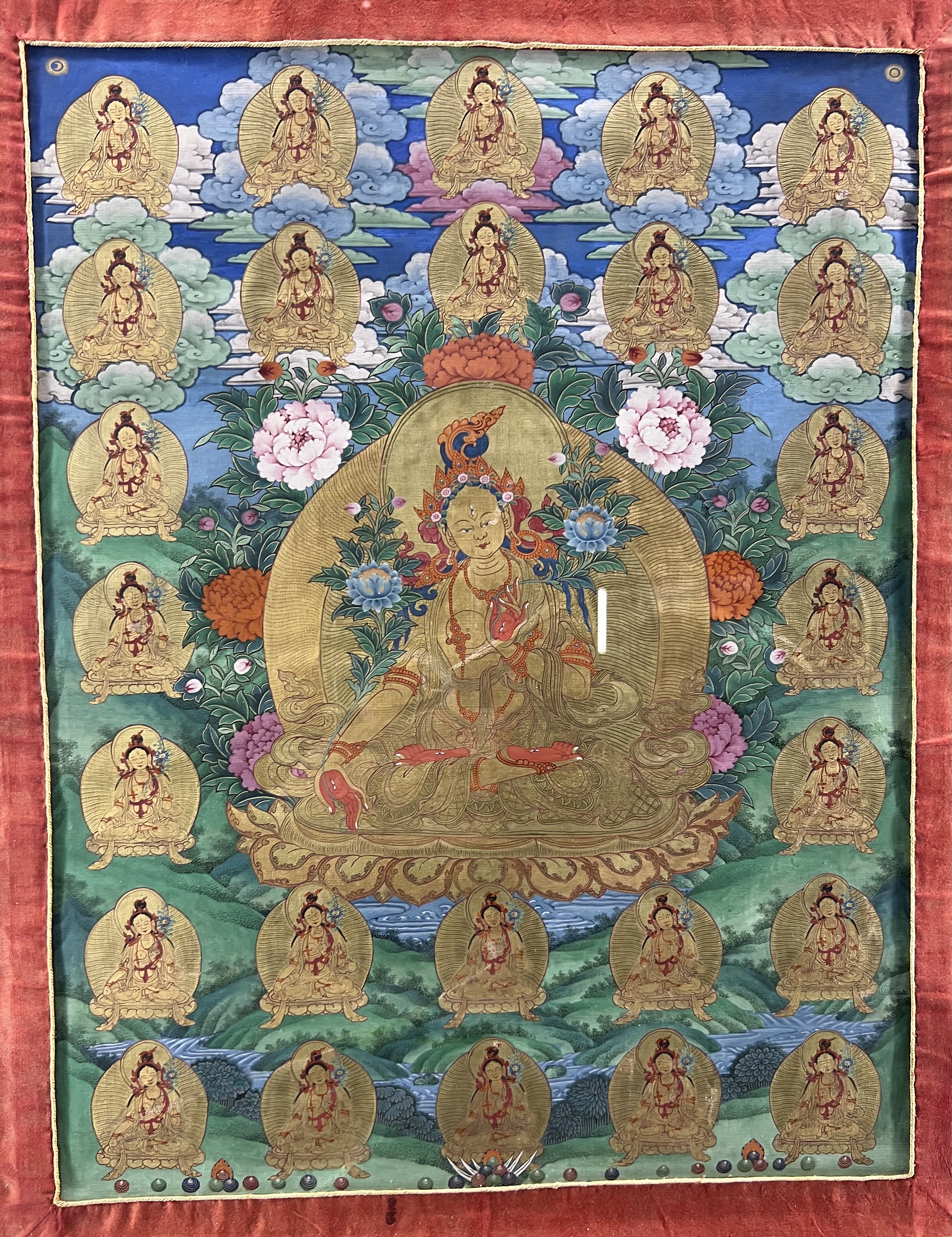
Тибет. ХІХ век
Белая Тара – одна из самых почитаемых форм Тары, дарующая долголетие, исцеление и устранение препятствий. Согласно тибетской традиции, ее образ восходит к видению учителя Вагишваракирти, жившего на рубеже X-ХІ веков. Дополнительные глаза на лбу, ладонях и ступнях символизируют способность видеть страдания существ во всех мирах и приходить им на помощь.
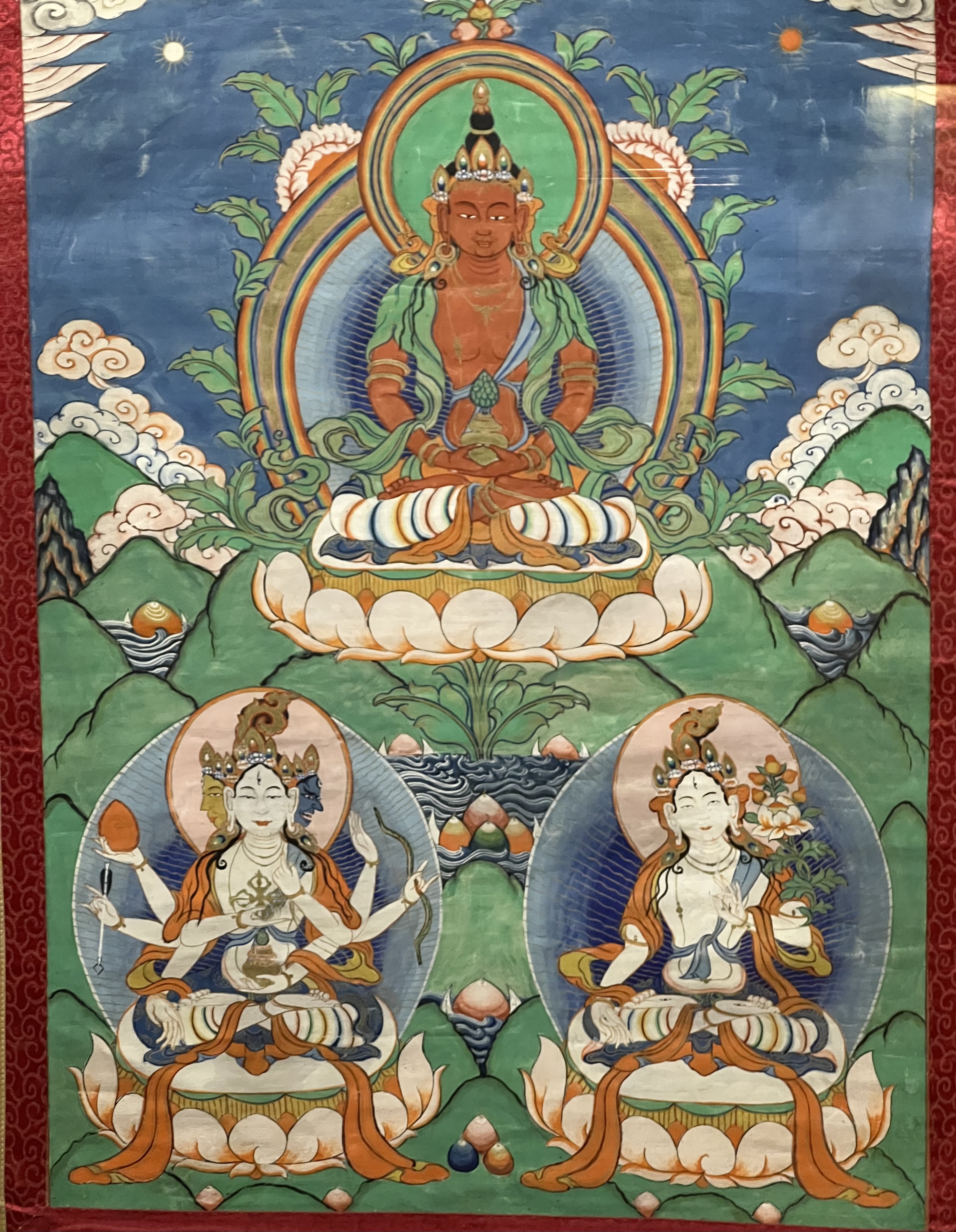
Тува. Начало ХХ века
ВАДЖРАЯНА В НЕПАЛЕ, ТИБЕТЕ И МОНГОЛИИ
В середине | тысячелетия из плавильного котла индийской мысли рождаются тантрические учения, формируется ваджраяна – Алмазная колесница. Согласно этой новой концепции, достижение просветления возможно в течение одной земной жизни, но для этого требуется мобилизация всех человеческих возможно-стей; помимо медитативных практик, важное значение придается ритуалам, повторению мантр и значительно возросшей роли учителя-наставника. Географическое положение Непала вдоль торговых путей из Индии через Гималаи в Тибет обеспечивало непрерывную передачу и взаимообмен культурными и религиозными идеями, художественными и техническими приемами буддийского искусства. Распространение буддизма в Тибете (историко- географической области в составе современного Китая) прошло в несколько этапов: от знакомства с учением тибетских царей до создания собственных буддийских школ: ньингма, кадам, сакья, карма-кагью. В XV веке известный тибетский учитель Цон-капа провел масштабную реформу буддизма в Тибете и основал новую школу гелуг, которая впоследствии стала главенствующей в Тибете. Тогда же возникают собственно тибетские стили в буддийском искус-стве. Во взаимодействии с художниками и ремеслен-никами Китая, где буддизм ваджраяны был известен с XIII века, появился сино-тибетский изобразительный стиль. Начиная с XVI века ваджраяна стала важной частью монгольской духовной культуры. Расцвет буд-дийского искусства здесь связан с именем извест-ного политического деятеля и художника Дзанаба-дзара, создавшего собственный художественный стиль живописи и ваяния. В XIX веке широкую извест-ность получили скульптурные мастерские Долоннора во Внутренней Монголии.
Буддийское учение зародилось на плодотворнейшей почве древне-индийской культуры и переняло от нее многие базовые представления: о перерождении, цикличности мира, иллюзорности повсе-дневного опыта, необходимости понять истинную реальность. В раннем буддизме достижение полного освобождения считалось возможным лишь при отказе от мирской жизни и посвящении в монахи. На рубеже новой эры набирает силу направление, в котором основной упор делается на философские аспекты буддизма. Последователи этого направления стали называть его «махаяна» (Великая или Большая колесница) или «широкий путь», тем самым провозглашая доступность учения Будды широким массам людей, чего не предусматривала теравада или, как ее называли приверженцы махаяны, «хинаяна» (Малая колесница). В этот период начинает формироваться буддийский изобразительный канон. В середине / тысячелетия как продолжение махаяны формируется ваджраяна – Алмазная колесница. Ваджраяна превращается в стройную систему в Гималайском регионе, широко распространяется на территории Монголии с XVI века. В XVII веке ей начинают покровительствовать маньчжуры, правители империи Цин (1644-1912). Постепенно с учением знакомятся монгольские народы, в том числе калмыки и буряты, а также тюркские – тувинцы, алтайцы. С принятием калмыками русского поддан-ства в начале XVII века Русское государство впервые вплотную столкнулось с буддизмом. Благодаря распространению буддизма среди бурят, в 1741 году указом императрицы Елизаветы Петровны буддизм был официально признан в России. В 1914 году нынешняя территория Республики тыва вступила под протекторат Рос-сийской империи, и таким образом буддизм стал неотъемлемой частью религиой культуры России. Антирелигиозное движение 1930-х годов в СССР, Тувинской Народной Республике, Монгольской Народной Республике и других государствах стало трагедией для буддийской религии и культуры: учителей репрессировали, монастыри и их имущество уничтожали. Выжившие монахи, прятавшие статуи и другие культовые предметы в тайниках, миряне, пронесшие веру сквозь годы запрета, музейные сотрудники, ученые и простые жители, передававшие предметы под охрану музеев, – благодаря им буддийское наследие России было сохранено и по крупицам собрано заново. Словосочетание «Алмазная колесница» (ваджраяна) – это метафора движения по духовному пути, достижение нирваны через ваджру. Изначально ваджра – это мифическое оружие ведийского бога Индры, с помощью которого он одолел гигант-ского змея Вритру – воплощение природной стихии. Тибетское название ваджры дордже переводится как «господин камней», то есть алмаз, чьими характеристиками являются непревзойденная прочность и твердость, а также чистота и прозрачность. Этими же качествами обладает буддийское учение: оно чистое и ясное, как пустота шуньята, которую невозможно разрушить никакими средствами. Ваджраяна открывает возможность однако путь этот чрезвычайно трудный – к практикам приступают под внимательным руководством наставника только искушенные адепты после многолетнего обучения, благочестивой жизни, подготовки сознания. Б
БУДДА ШАКЬЯМУНИ
«Будда» дословно переводится с санскрита как «про-будившийся». Первоначально такое имя получил Сиддхартха Гаутама, основатель учения, который в ходе долгих лет исканий и медитации достиг просветления под деревом бодхи. Позже слово стало обозначать высшие сущности буддийской вселенной.
Таким образом, Будда Шакьямуни буквально – это
« Пробужденный мудрец из рода Шакьев». Точные даты жизни Будды неизвестны, но исследователи склоняются к тому, что это VI-V века до н.э.
Хотя историчность этой фигуры не подлежит сомнению, со временем его биография обросла чудесными преданиями. Основные ее вехи таковы: чудес-ное зачатие (его матери Майе приснилось, что в ее бок входит белый слон) и рождение в Лумбини (современ-ный Непал); жизнь во дворце до столкновения со ста-риком, больным, похоронной процессией и стран-ствующим отшельником; побег из дворца, обучение у аскетов; медитация в одиночестве под деревом бодхи и просветление (открытие четырех благородных истин); первая проповедь, собрание единомыш-ленников (сангха) и распространение учения во время странствий по долине реки Ганг; уход в паринирвану (полное успокоение выход из круга перерождений),

